
Visiting a Korean Home: Etiquette Guide for Foreigners
Last Chuseok I invited one of my restaurant’s part-timers — a graduate student from Canada with nowhere to go for the holiday — to my apartment for dinner. He showed up in his coat and shoes, holding nothing, and stood in my doorway clearly unsure whether to step forward. Within thirty seconds we’d sorted it out and had a wonderful evening, but I could see how much he’d been dreading getting it wrong. If you’ve been invited to a Korean home, this guide on visiting a Korean home etiquette will spare you that doorway hesitation. None of it is hard — it’s just a handful of customs worth knowing before you knock.

The One Non-Negotiable: Shoes Off
If you remember nothing else, remember this: you take your shoes off at the entrance. Every Korean home has a small entryway (현관, hyeon-gwan), usually a step down or a different floor material, and shoes come off there — never worn into the living space. Floors in Korea are for sitting, eating, and often sleeping, and they’re kept clean because of exactly this rule.
Your host may offer indoor slippers, or you may go in socks. Either way, don’t step past the entryway with your shoes on; it’s the single fastest way to make a Korean host wince. My Canadian guest caught himself just in time when he saw my own shoes lined up by the door.
Don’t Arrive Empty-Handed
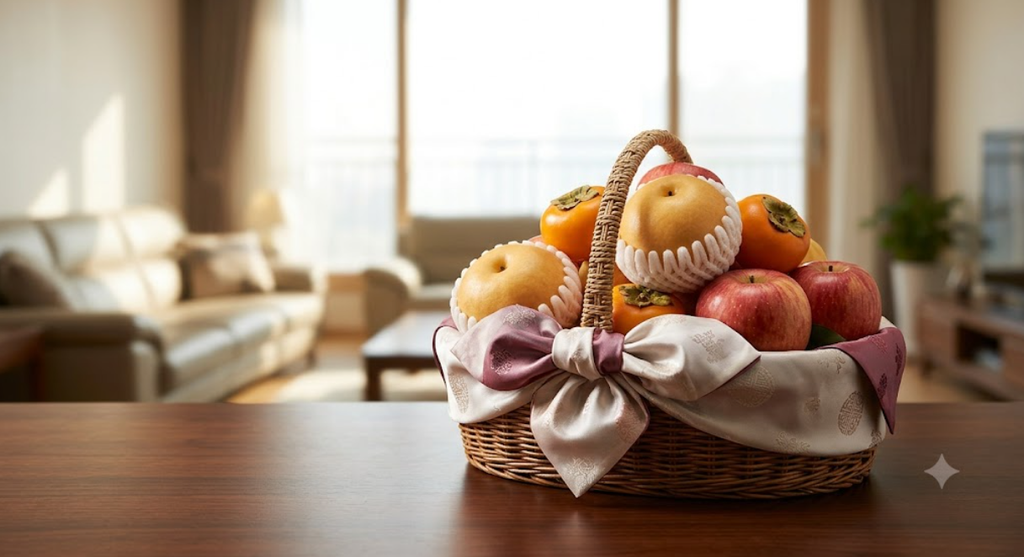
Koreans have a saying that you don’t visit someone’s home 빈손으로 (empty-handed). A small gift is a common way to show appreciation, although expectations vary by household and occasion. You don’t need anything lavish — good options include:
- A box of fruit (a classic, always welcome)
- Dessert, cake, or nice drinks
- Something from your home country, if you’re visiting
Hand it over near the door with both hands and a warm “초대해 주셔서 감사합니다” (thank you for inviting me). It’s a small gesture that lands beautifully.
At the Table
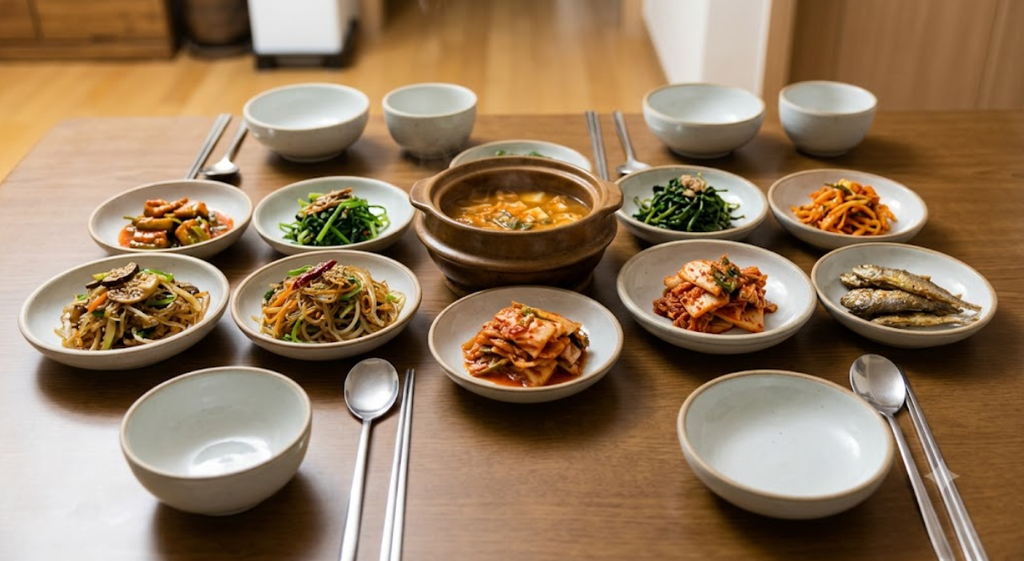
Korean home cooking is an act of love, and a few table customs honor that:
- Before eating, say “잘 먹겠습니다” (jal meok-ge-sseum-ni-da) — roughly “I will eat well,” a thank-you to the person who cooked.
- After the meal, say “잘 먹었습니다” (jal meo-geo-sseum-ni-da) — “I ate well.” Even if your Korean is otherwise nonexistent, these two phrases will win the room.
- If elders are present, it’s polite to wait for the oldest person to lift their spoon before you start.
- Compliment the food — but if the host waves it off modestly, that’s just the Korean modesty reflex at work.
A Few Small Graces
- Greet elders first, with a slight bow of the head.
- Don’t wander — wait to be shown where to sit rather than opening doors or exploring.
- Offer to help, even if you’re gently refused; the offer itself is appreciated.
- When you enter, a soft “실례합니다” (sil-lye-ham-ni-da — “pardon the intrusion”) as you step in sets a respectful tone.
The Phrases That Make an Impression
- Thank you for inviting me → 초대해 주셔서 감사합니다 (cho-dae-hae ju-syeo-seo gam-sa-ham-ni-da)
- Pardon the intrusion (entering) → 실례합니다 (sil-lye-ham-ni-da)
- Before eating → 잘 먹겠습니다 (jal meok-ge-sseum-ni-da)
- After eating → 잘 먹었습니다 (jal meo-geo-sseum-ni-da)
Master just those four, deliver them at the right moment, and your Korean host will be quietly delighted.
My Canadian part-timer now comes over every Chuseok, and he arrives with a box of pears and his shoes half-off before he’s through the door. The etiquette that once terrified him turned out to be the easiest part — it’s really just a way of saying thank you for having me in a Korean accent.
고구마





댓글 0
첫 댓글을 남겨보세요.