
Korean Drinking Etiquette: Rules Every Foreigner Should Know
At my first proper 회식 (staff dinner) years ago as a young cook, I made the classic rookie mistake: I filled my own soju glass while my head chef watched. He didn’t scold me — he just quietly took the bottle from my hand and poured for me instead, which was somehow more mortifying than any lecture. That’s how I learned that Korean drinking etiquette is less about rules and more about a kind of choreography of respect. It flows from the same age-and-hierarchy logic that shapes so much of Korean life, and once you feel the rhythm of it, drinking with Koreans becomes one of the warmest ways to bond.
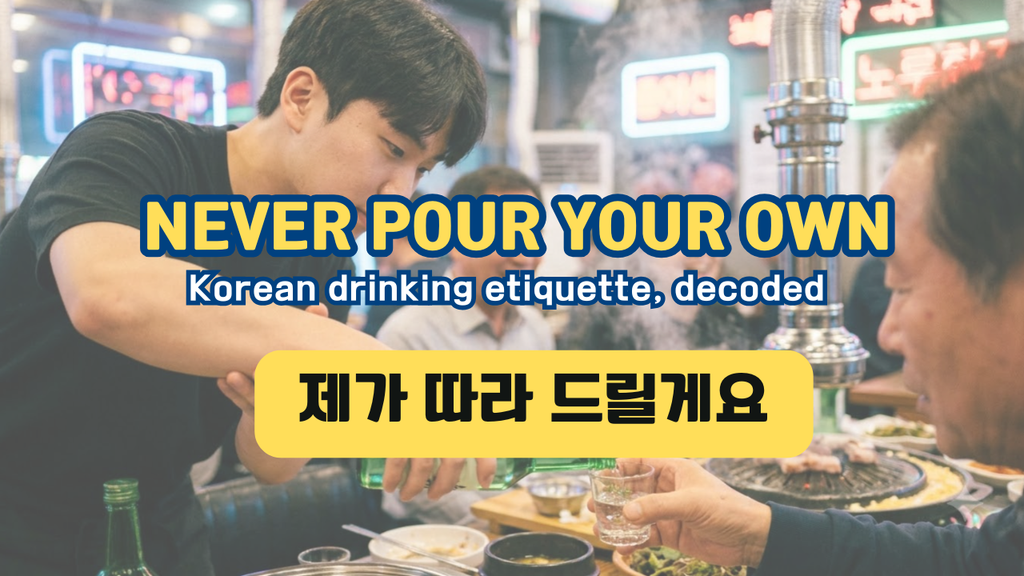
The Golden Rule: Never Pour Your Own
The foundation of it all: you don’t fill your own glass. You pour for others, and someone pours for you. Keep a quiet eye on your companions’ glasses, and when one runs low, offer to refill it. Someone will do the same for you. An empty glass sitting in front of you is a small signal that you’re being neglected — so a good drinking companion keeps others topped up.
A related old-school note: traditionally you wait until a glass is empty before refilling it, rather than topping off a half-full one. Younger crowds are relaxed about this, but with older company it’s a nice touch to know.
The Two-Hand Rule (This Is the Big One)
When you’re drinking with someone older or more senior, hands matter:
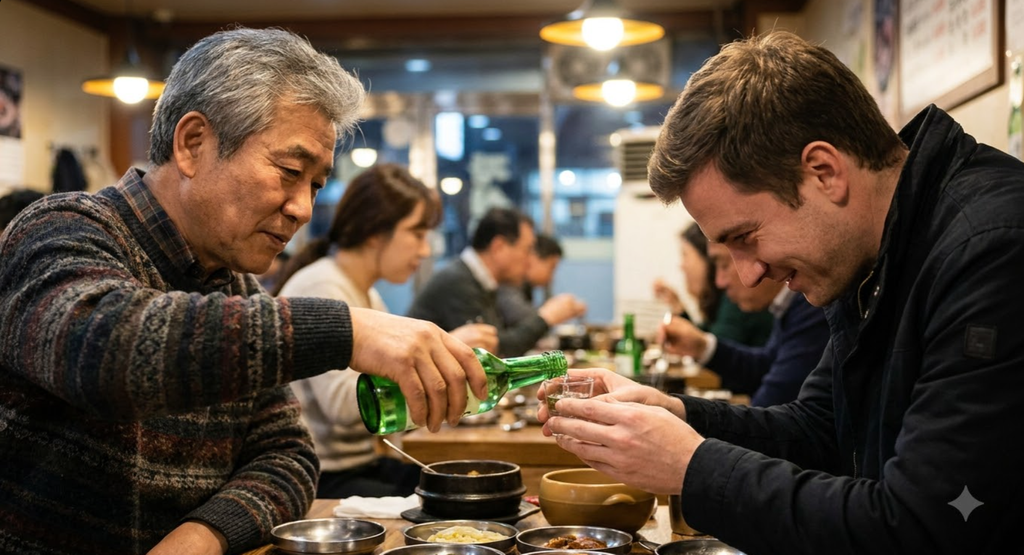
- Pouring for an elder: hold the bottle with your right hand and lightly support your right forearm or wrist with your left hand. Two hands = respect.
- Receiving a drink from an elder: hold your glass with both hands as they pour.
- Offering your glass: the same two-hand gesture applies.
This mirrors the respect built into Korean speech levels and titles — the same logic behind how age shapes the way Koreans address each other. With friends your own age, one hand is fine and casual.
Turning Away to Drink
Here’s the move foreigners always find charming once they learn it: when you take a drink in front of someone notably older, you turn your head slightly away from them and cover the glass a little with your hand. It is a traditional gesture of respect that is still commonly seen when drinking with older people. — you don’t drink square-on to an elder. It takes two seconds and reads as genuine respect.
Toasts and the First Drink
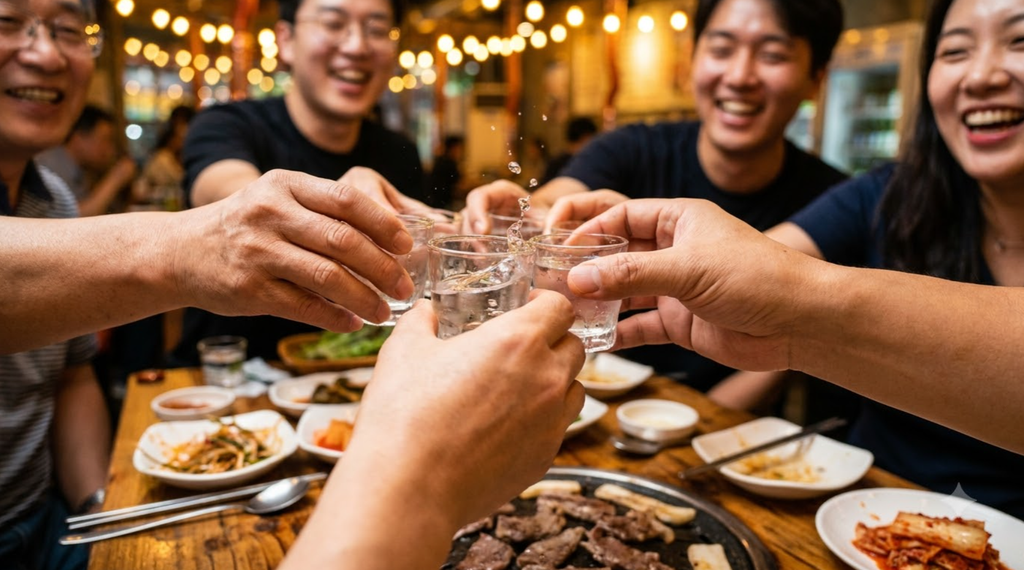
- The toast is 건배! (geon-bae!) or the more casual 짠! (jjan!) — glasses up, a clink, and go.
- 원샷 (won-syat) means “bottoms up,” downing the glass in one — common but never truly mandatory; pace yourself.
- If an elder offers you the first drink, it’s gracious to accept it rather than refuse outright.
The Phrases to Know
- Please receive a glass (offering someone a drink) → 한 잔 받으세요 (han jan ba-deu-se-yo)
- Let me pour for you → 제가 따라 드릴게요 (je-ga tta-ra deu-ril-ge-yo)
- Cheers! → 건배! (geon-bae!) / 짠! (jjan!)
- I can’t drink (much) → 저 술 잘 못 해요 (jeo sul jal mot hae-yo)
That last one is worth keeping in your pocket. Korean drinking culture can be generous to a fault, and a polite “저 술 잘 못 해요” is a perfectly acceptable way to pace yourself — no one will push a genuine limit once you’ve said it warmly.
You Don’t Have to Drink
One honest, important point: despite the reputation, you are never obligated to drink alcohol in Korea. If you don’t drink, say so early and kindly; you can toast and pour for others with a soft drink in hand and still be fully part of the evening. Good hosts respect it completely.
I think back on my head chef taking that bottle from me and smile now — he wasn’t judging me, he was teaching me. Fill your neighbor’s glass before your own, use two hands with your elders, and turn away for that first respectful sip. Do that, and you won’t just be drinking in Korea; you’ll be doing it like you belong.
고구마





댓글 0
첫 댓글을 남겨보세요.