
Korean Pharmacy Guide: How to Describe Your Symptoms
My friend Aisha caught a nasty cold on her third day in Seoul, walked into a pharmacy, and — not knowing the words — just kept pointing at her throat and looking miserable until the pharmacist gently figured it out. She got the help she needed, but it was more stressful than it had to be. That’s why I put together this Korean pharmacy guide. The goal here isn’t to teach you medicine; it’s to give you the handful of simple phrases that let you tell a pharmacist exactly what’s wrong. As a Korean who has walked countless visiting friends to the neighborhood 약국 (yak-guk), I promise this is easier than Aisha’s game of charades.
A quick, important note before we start: this is a language guide, not medical advice. For anything serious, persistent, or worrying, please see a doctor at a clinic (병원). The phrases below are just to help you communicate — the pharmacist is the professional who decides what’s appropriate.
How the Korean Pharmacy System Works
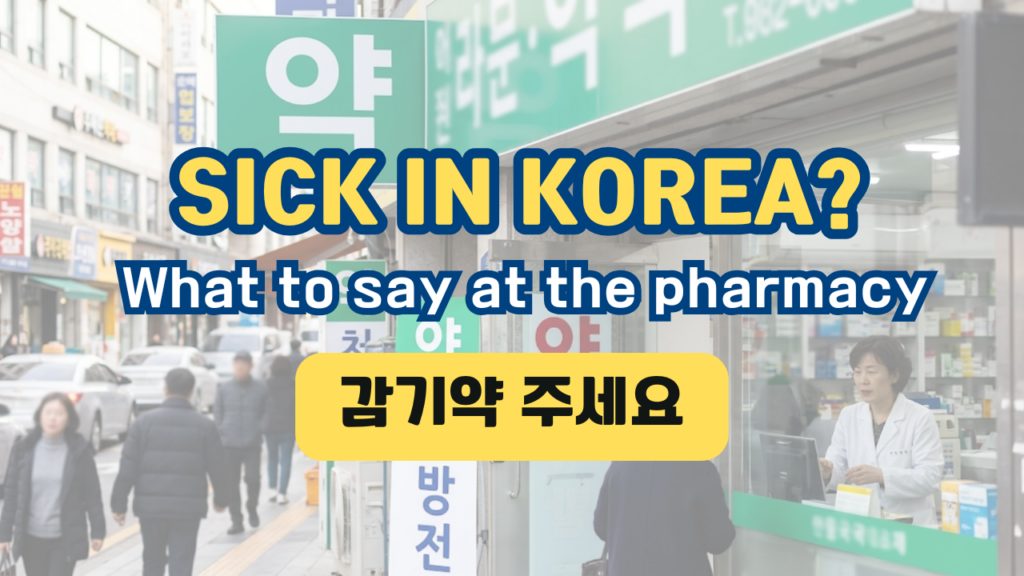
Understanding the setup saves a lot of confusion. In Korea, a pharmacy (약국) is a separate shop from a clinic, usually marked with a sign showing the character 약 (yak, “medicine”), often in green. Inside, the pharmacist (약사, yak-sa) can listen to your symptoms and recommend an appropriate over-the-counter option for everyday complaints like a mild cold, a headache, or an upset stomach.
The key thing to know: for minor issues, you can go straight to the pharmacy — no appointment, no doctor first. But for anything that needs a prescription, the order is: clinic first, get a 처방전 (prescription), then bring it to the pharmacy to be filled. Many pharmacies are accustomed to helping customers describe common symptoms and ask about over-the-counter products.
The Symptom Phrases That Actually Matter
You don’t need medical vocabulary. You need a few plain sentences about what hurts. Here’s Korean first, then rough pronunciation, then the meaning.
The core “it hurts” pattern — just name the body part + 아파요 (a-pa-yo, “it hurts”):
- My head hurts → 머리가 아파요 (meo-ri-ga a-pa-yo)
- My throat hurts → 목이 아파요 (mok-i a-pa-yo)
- My stomach hurts → 배가 아파요 (bae-ga a-pa-yo)
Common specific symptoms
- I have indigestion → 소화가 안 돼요 (so-hwa-ga an dwae-yo)
- I have a fever → 열이 나요 (yeol-i na-yo)
- I have a cough → 기침이 나요 (gi-chim-i na-yo)
- I have a runny nose → 콧물이 나요 (kon-mul-i na-yo)
- I have body aches / flu-like aches → 몸살이 났어요 (mom-sal-i na-sseo-yo)
- I have diarrhea → 설사해요 (seol-sa-hae-yo)
Asking for help with it
- Do you have medicine for a headache? → 두통약 있어요? (du-tong-yak i-sseo-yo?)
- Please give me some cold medicine → 감기약 주세요 (gam-gi-yak ju-se-yo)
Notice the pattern for asking: the name of the ailment + 약 (yak, “medicine”). 두통 (headache) → 두통약. 감기 (cold) → 감기약. You’re not choosing the product — you’re telling the pharmacist the category, and they take it from there.
What the Pharmacist Will Ask You
The pharmacist will usually ask a couple of quick questions. Recognizing them keeps you calm:
- Where does it hurt? → 어디가 아프세요? (eo-di-ga a-peu-se-yo?)
- Since when? → 언제부터 아팠어요? (eon-je-bu-teo a-pa-sseo-yo?)
- Do you have any allergies? → 알레르기 있어요? (al-le-reu-gi i-sseo-yo?)
That last one matters, so it’s worth knowing how to answer it honestly:
- I have allergies → 알레르기가 있어요 (al-le-reu-gi-ga i-sseo-yo)
- I don’t have any allergies → 알레르기 없어요 (al-le-reu-gi eop-seo-yo)
If you take regular medication or have a condition, mention it — and if you can’t explain it in Korean, this is a perfect moment for a translation app. I always tell friends to keep Papago open and ready; typing your condition and showing the screen works beautifully.
A Real Pharmacy Conversation
Here’s how it typically flows, so nothing catches you off guard:
You: 목이 아파요. (My throat hurts.)
Pharmacist: 언제부터 아팠어요? (Since when?)
You: 어제부터요. (Since yesterday.)
Pharmacist: 열도 나요? (Do you have a fever too?)
You: 아니요, 목만 아파요. (No, just my throat.)
Pharmacist: 알레르기 있어요? (Any allergies?)
You: 없어요. (None.)
From there, the pharmacist recommends something suitable and explains how to take it. If you’re not sure you understood the instructions, it’s completely fine to ask them to write it down or show you on the box.
When the Pharmacy Is Closed: After-Hours Options
Here’s a practical fact visitors don’t know: many pharmacies close in the evening and on Sundays. So what do you do at midnight with a headache?
Two things help. First, since a 2012 rule, Korean convenience stores carry a small set of basic, safe over-the-counter items — a limited range of things like certain cold, digestive, and pain-relief products, in small quantities. It’s not a full pharmacy, but it can bridge a late-night gap. Second, larger cities have designated late-night public pharmacies (공공심야약국), which you can look up online when you’re stuck.
For a proper consultation, though, the daytime 약국 is always the better call.
FAQ
Do I need to see a doctor before going to a Korean pharmacy?
Not for minor, everyday complaints — you can walk straight into a pharmacy. You only need a clinic first when something requires a prescription.
Will the pharmacist speak English?
Some do, especially in tourist and expat areas, but many don’t. That’s exactly why the simple phrases above — plus a translation app as backup — make such a difference.
Where can I buy basic medicine at night?
Convenience stores stock a limited selection of safe over-the-counter items, and big cities have late-night public pharmacies you can search for.
What if I can’t describe my symptoms?
Point to where it hurts and use the “[body part] + 아파요” pattern, or type it into Papago and show the screen. Pharmacists are used to helping people who don’t speak much Korean.
The Bottom Line
You don’t need to memorize medical terms to handle a Korean pharmacy — you need “머리가 아파요,” a few symptom words, and the confidence that the pharmacist will take it from there. Keep a translation app handy for anything complicated, remember that convenience stores can cover a late-night gap, and always see a doctor for anything that feels serious. Aisha now walks into a pharmacy and just says what hurts — no charades required. After this, so will you.
고구마



댓글 0
첫 댓글을 남겨보세요.