
How to Rent a Bike in Seoul (Ttareungi Guide)
Last spring I took my friend Marco down to the Han River to ride bikes, and we stood at a Ttareungi station for a solid ten minutes while his foreign credit card got rejected over and over. He was ready to give up — until I showed him the one workaround locals actually use. That frustrating little moment is exactly why this guide on how to rent a bike in Seoul exists. The bikes are an affordable way to get around Seoul, although some visitors may encounter payment issues. As a Seoul native who cycles the Han River all summer, let me get you on a bike fast — and show you how to dodge the errors that stopped Marco cold.
Why Ttareungi Is the Best Way to See Seoul
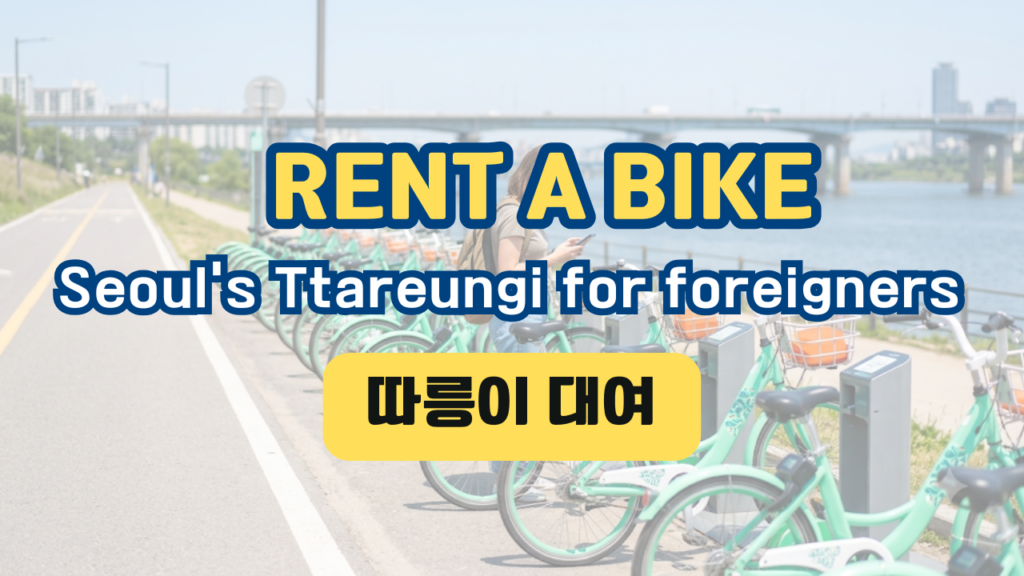
Seoul’s subway is world-class, but for that awkward distance that’s too far to walk and too short for a taxi, the city’s public bike is king. It’s called 따릉이 (Ttareungi) — named after “따르릉,” the sound of a bicycle bell — and you’ll spot its bright mint-green frames everywhere. The Seoul city government runs it, with tens of thousands of bikes at thousands of docking stations across town.
The real magic is the Han River bike path, a wide, car-free route running roughly 41 km along both banks. Cruising it past the bridges, especially during cherry blossom season, is honestly one of the best cheap experiences in the whole country. And “cheap” is the word: a full day of riding costs less than a fancy coffee.
How to Rent a Ttareungi, Step by Step
The good news: you do not need a Korean phone number or even an account to ride. Here’s the flow.
- Download the app. Search for “Seoul Bike” (also listed as Seoul Public Bike) in your app store. It supports English, Chinese, and Japanese — it usually follows your phone’s language, but you can set English manually.
- Choose the Foreigner pass. On the login screen, select the Foreigner option. You can buy a pass without creating a full account.
- Pick a duration. Options run from a 1-hour or 2-hour pass up to a 1-day pass (around 5,000 won), which is the easiest choice for a first-timer.
- Pay, and the app gives you a rental code / password.
- Go to any station, find a green bike, and enter the code on the bike’s holder terminal to unlock it. Ride away.
That’s it — when it works. The step that goes wrong is step 4, so let’s fix it properly.
The Payment Error Everyone Hits (and How to Fix It)
Here’s the honest truth for 2026: foreign Visa and Mastercards work for most riders now, but a meaningful number still get rejected at the payment screen. This is what happened to Marco. The usual culprit is the 3D Secure authentication step that Korean payment gateways use — many overseas cards simply don’t play nicely with it.
If your card keeps failing, don’t stand there re-entering it like we did. Use one of these local workarounds instead:
- Tmoney GO app. In 2026 this is the top recommendation for foreigners. It bundles Ttareungi rentals into one platform and handles international cards far more reliably than the standalone bike app. If the original app rejects you, switch to Tmoney GO.
- Seoul Climate Card (기후동행카드). If you’re staying a while, this transit pass can include Ttareungi access — link your card number in Tmoney GO and rides are covered with no per-ride payment. One tip: wait about an hour after topping up before linking, so the system has time to sync.
- WOWPASS. This foreign-tourist debit card (loaded with Korean won) usually sails through where a raw foreign credit card fails.
Any one of these turns the payment wall into a non-issue. Marco used Tmoney GO and was riding within two minutes.
Other Common Errors, Solved
Two more glitches catch people, and both have simple fixes.
“The app can’t find the bike.” This is almost never a broken bike. Go into your phone settings and set Location to “Always Allow” and make sure Bluetooth is on — the app needs both to talk to the station.
“The QR code won’t scan.” Often it’s your connection. If your phone is clinging to a weak public Wi-Fi like “Seoul_Free,” switch to cellular data — the lag usually disappears instantly.
And if a specific bike genuinely feels broken — flat tire, wobbly brake — just dock it, grab another, and if you like, report it in the app. A useful phrase if you need to flag it to someone: “이 자전거 고장났어요” (i ja-jeon-geo go-jang-na-sseo-yo — “This bike is broken”).
Returning the Bike Without Getting Charged Extra
This is where careless riders lose money. Your pass covers rides in chunks — typically you must dock the bike every 60 or 120 minutes (depending on your pass) to avoid a surcharge, which runs around 200 won per extra 5 minutes.
To return: ride to any station, push the bike firmly into an empty holder until you hear a click, and then confirm the return in the app. Don’t walk away until the app says the bike is returned — a bike that didn’t dock properly keeps the clock running under your name. If you’re doing a long Han River day, just re-dock and instantly re-rent every hour to keep resetting the timer.
One honest note on helmets: Korean law technically calls for them, but enforcement is minimal and Ttareungi bikes don’t come with one. Most casual riders go without; if you want one, you’ll need to bring your own.
A Quick Phrase for Finding a Station
Most of this happens in the app, but if you’re lost and want to ask a passerby:
- Where’s the nearest Ttareungi station? → 가까운 따릉이 대여소 어디예요? (ga-kka-un tta-reung-i dae-yeo-so eo-di-ye-yo?)
FAQ
Do I need a Korean phone number to rent a Ttareungi?
No. The Seoul Bike app has a Foreigner pass that works without a Korean number or a full account.
My foreign card keeps getting rejected. What now?
It’s usually the 3D Secure step. Switch to the Tmoney GO app, or use a Seoul Climate Card or WOWPASS — any of these bypasses the problem.
How much does it cost?
Very little — a 1-day pass is around 5,000 won, with shorter 1- and 2-hour passes available too. It’s one of the cheapest ways to get around Seoul.
Where should I ride as a first-timer?
The Han River path is flat, wide, car-free, and scenic — the perfect place to start.
The Bottom Line
Once you know to grab the Foreigner pass, and — crucially — to reach for Tmoney GO or a Climate Card the moment your card gets rejected, how to rent a bike in Seoul stops being a puzzle and becomes a five-minute habit. Pack light, dock every hour, and enjoy the river. Before you set off, it’s worth knowing how to raid a convenience store for a cheap riverside snack and how to order an iced coffee to go for the ride. Marco now rents a Ttareungi every time he visits — payment error and all behind him. After this, you’ll skip straight to the fun part.
고구마




댓글 0
첫 댓글을 남겨보세요.