
How to Return Items in Korea (Olive Young Guide)
My friend Priya bought a sheet-mask haul at Olive Young, realized the next day that one product wasn’t what she wanted, and almost didn’t return it because she assumed the language barrier made it impossible. It took about thirty seconds and one sentence. That’s the thing about learning how to return items in Korea — it feels intimidating, but the actual interaction is short and predictable once you know the two magic words and what the clerk will ask. As a Korean who returns and exchanges things more than I’d like to admit, let me hand you the exact script for Olive Young, clothing shops, and just about any store.
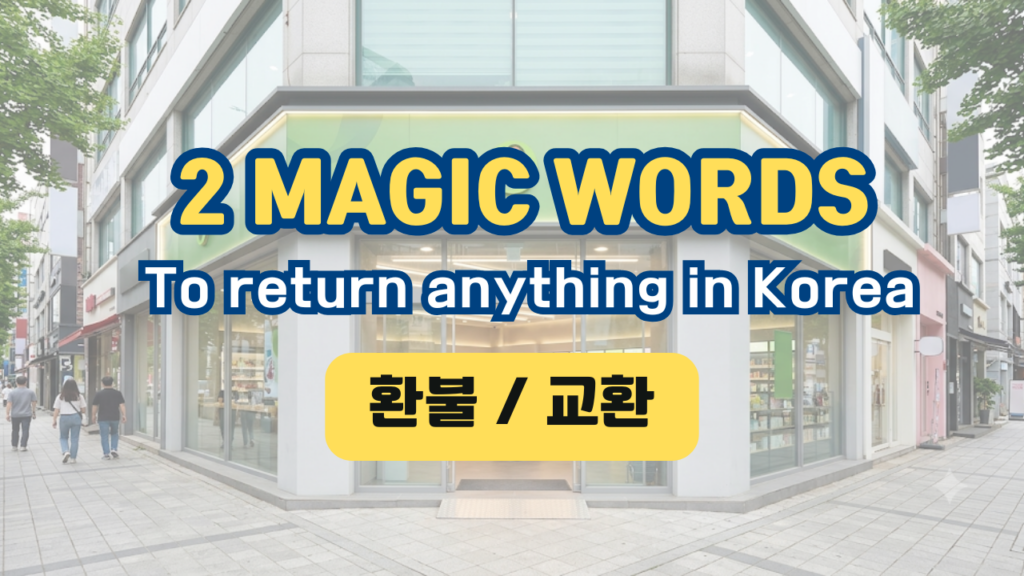
The Two Words That Do Everything
Before anything else, learn these two, because every return interaction hinges on them:
- 환불 (hwan-bul) = refund (money back)
- 교환 (gyo-hwan) = exchange (swap for another item or size)
Decide which one you want before you walk up to the counter, and the whole conversation gets easier. Want your money back? That’s 환불. Just need a different size? That’s 교환 — and stores are generally happier to do exchanges than refunds.
The One Thing You Must Bring: Your Receipt
Here’s the rule that trips people up: bring your receipt (영수증, yeong-su-jeung). In Korea, a receipt makes returns smooth and predictable; without one, you’re at the mercy of store policy and may only get store credit or an exchange, if anything.
A few more things that matter for a clean return:
- The item should be unused, with tags and packaging intact. Clothes with tags still on, cosmetics unopened.
- Refunds usually go back to the original payment method — so if you paid by card, bring that same card.
- Most stores accept returns within a set window (commonly around two weeks). Olive Young and similar chains follow this kind of policy, so don’t sit on it for a month.
The Phrases for Refunds and Exchanges
Here’s your toolkit — Korean, rough pronunciation, meaning.
Starting the return
- I’d like to return this → 이거 환불하고 싶어요 (i-geo hwan-bul-ha-go si-peo-yo)
- I’d like to exchange this → 이거 교환하고 싶어요 (i-geo gyo-hwan-ha-go si-peo-yo)
- Can I get a refund? → 환불 돼요? (hwan-bul dwae-yo?)
For clothing size issues
- Can I exchange it for a different size? → 다른 사이즈로 교환 돼요? (da-reun sa-i-jeu-ro gyo-hwan dwae-yo?)
- It’s too big → 너무 커요 (neo-mu keo-yo)
- It’s too small → 너무 작아요 (neo-mu ja-ga-yo)
- Do you have a bigger size? → 더 큰 사이즈 있어요? (deo keun sa-i-jeu i-sseo-yo?)
Explaining the reason
- Here’s the receipt → 영수증 여기 있어요 (yeong-su-jeung yeo-gi i-sseo-yo)
- I just changed my mind → 단순 변심이에요 (dan-sun byeon-sim-i-e-yo)
- It’s defective → 불량이에요 (bul-lyang-i-e-yo)
That last distinction matters: if something is genuinely defective (불량), stores are very accommodating. If it’s simply a change of mind (단순 변심), they’ll still usually help within the return window, but the tags-and-receipt rules apply more strictly.
What the Clerk Will Ask You
The clerk will run through a short, predictable set of questions. Recognizing them is half the battle:
- Do you have the receipt? → 영수증 있으세요? (yeong-su-jeung i-sseu-se-yo?)
- Which card did you pay with? → 어떤 카드로 결제하셨어요? (eo-tteon ka-deu-ro gyeol-je-ha-syeo-sseo-yo?)
- Would you like a refund or an exchange? → 환불이세요, 교환이세요? (hwan-bul-i-se-yo, gyo-hwan-i-se-yo?)
To that last question, just answer with one of your two magic words: “환불이요” (refund) or “교환이요” (exchange).
A Real Return Conversation
Here’s the whole thing at an Olive Young counter, start to finish:
You: 이거 환불하고 싶어요. (I’d like to return this.)
Clerk: 영수증 있으세요? (Do you have the receipt?)
You: 네, 여기요. (Yes, here.)
Clerk: 어떤 카드로 결제하셨어요? (Which card did you pay with?)
You: 이 카드요. (This card.)
Thirty seconds, done — the exact interaction Priya was dreading. And remember, since there’s no tipping culture and prices are fixed, there’s no awkward haggling involved; it’s a clean, procedural exchange.
What Usually Can’t Be Returned
Save yourself a wasted trip by knowing the common exceptions:
- Opened cosmetics or skincare, for hygiene reasons — a big one at Olive Young. If you’ve broken the seal, assume it’s final.
- Underwear and swimwear, also hygiene-related.
- Final-sale or clearance items (세일 상품) are often exchange-only or non-refundable — check at purchase.
- Items without tags or packaging, or past the return window.
When in doubt, it’s totally normal to ask at the time of purchase: “환불 돼요?” (Can this be returned?) — especially for sale items.
FAQ
Do I really need the receipt to return something in Korea?
Strongly recommended. With it, returns are smooth; without it, you may be limited to store credit or an exchange, depending on the shop.
Can I return opened cosmetics at Olive Young?
Generally no — opened or used beauty products are treated as final for hygiene reasons. Unopened items with the receipt, within the window, are fine.
Is a refund the same as a tourist tax refund?
No — and people mix these up. 환불 means returning an item for your money back. A tax refund (세금 환급) is a separate tourist perk where you reclaim VAT on purchases with your passport. Different process entirely.
How long do I have to return something?
Policies vary, but many stores use a window of around two weeks with the receipt and tags intact. Don’t wait a month.
The Bottom Line
Once you’ve got your two magic words — 환불 for a refund, 교환 for an exchange — plus your receipt and the original card, you know how to return items in Korea with zero drama. Keep tags on until you’re sure, don’t open cosmetics you might send back, and ask “환불 돼요?” on sale items before buying. It pairs naturally with knowing how to earn points and stack deals while you shop and how to order your victory coffee afterward. Priya now returns things without a second thought — one sentence, receipt out, done. After this, so will you.
고구마


댓글 0
첫 댓글을 남겨보세요.