
How to Use Kakao Taxi in Korea (Foreigner Guide)
Late one night, a couple of regulars from abroad left my restaurant, stood on the curb, and waved their arms at passing taxis for a solid twenty minutes — while I watched from the doorway, wanting to laugh and rescue them at the same time. Here’s the thing they didn’t know: using a taxi app is often more convenient than trying to flag down a cab on the street. You tap an app. Learning how to use Kakao Taxi in Korea is one of the biggest quality-of-life upgrades for any visitor, because it turns “will a taxi ever stop for me?” into a two-minute, stress-free ride. As a Seoul local who takes cabs all the time and has walked plenty of friends through it, let me set you up.
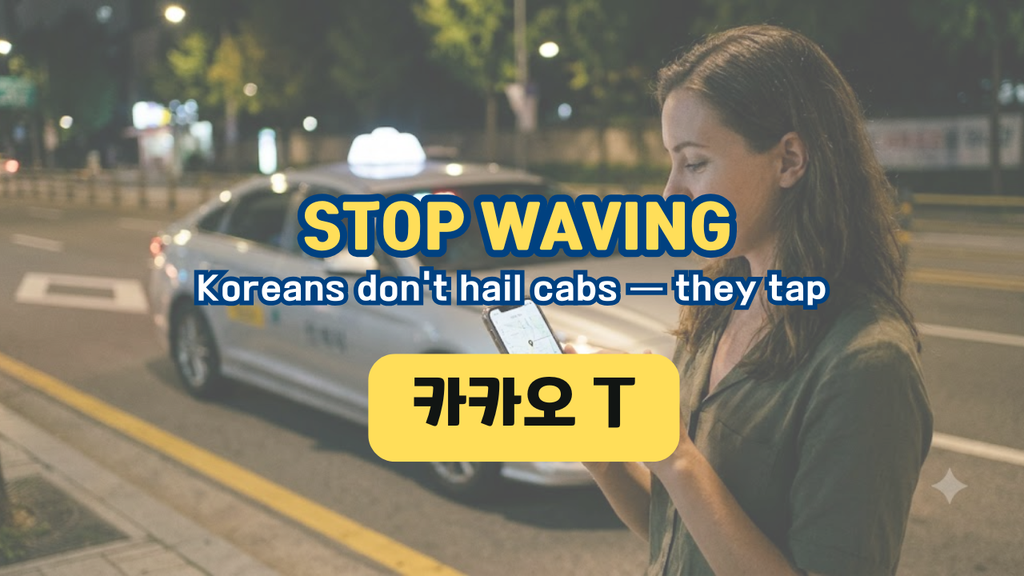
Why the App Beats Waving Your Arm
Street-hailing still technically works in Korea, but it’s the hard way — empty cabs may pass you, and once you’re in, you have to somehow pronounce a Korean address to a driver who may not speak English. Both problems vanish with 카카오T (Kakao T), the dominant taxi app here.
The magic is the destination pin. You set where you’re going in the app, the driver receives it digitally, and — this is the key part — you often don’t have to say the address out loud at all. The car already knows where it’s headed. That single feature removes the scariest part of taking a taxi in a language you don’t speak.
How to Book a Ride, Step by Step
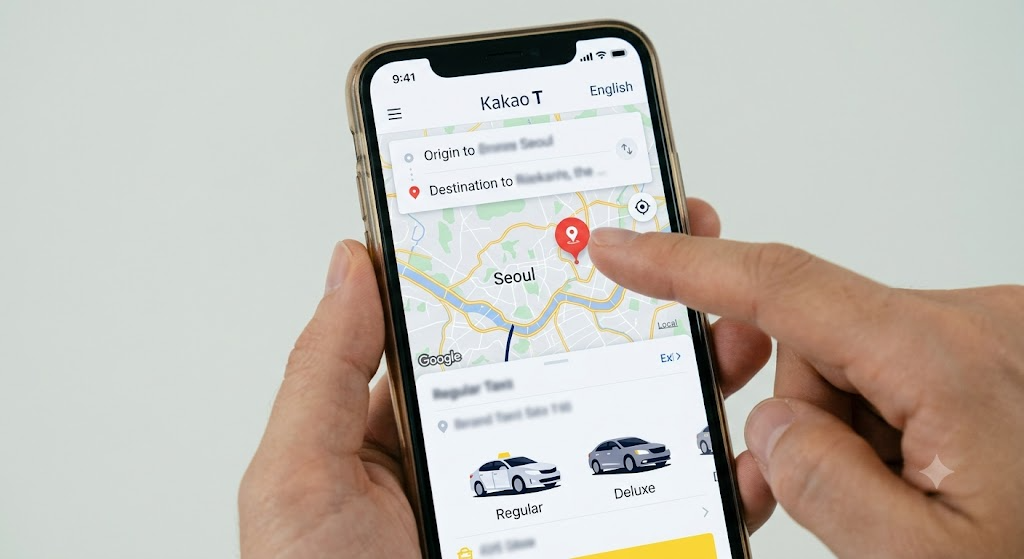
- Download 카카오T (Kakao T) from your app store. You can set the interface to English.
- Set your pickup and destination. Your pickup usually auto-fills from GPS; search or drop a pin for your destination.
- Choose a taxi type. You’ll usually see options like 일반 (regular) and 모범/블랙 (deluxe) — regular is the standard, cheapest choice; deluxe is pricier and fancier.
- Confirm and wait for a match. The app shows the driver’s car, plate number, and arrival time on a live map.
- Get in, ride, and pay — either automatically through a registered card, or directly to the driver at the end.
An honest heads-up for visitors: like many Korean apps, Kakao T works most smoothly with a Korean phone number and a local payment method. Registering a foreign card can be hit or miss. If that trips you up, you can still often use it in “pay the driver directly” mode and settle by card or cash in the car. The alternative app UT is also worth having as a backup.
What It Costs (and the Late-Night Catch)
Taxis in Korea are reasonably priced. In Seoul, the meter starts in the mid-4,000-won range for a regular taxi (fares are raised periodically, so treat this as a ballpark), then climbs by distance and time.
The one thing that surprises people: the late-night surcharge. From late evening into the early morning, fares jump by roughly 20% — and even more in the deepest late-night hours. So the same ride home costs noticeably more at 2 a.m. than at 2 p.m. It’s not an error; it’s the standard 심야 (late-night) rate. This matters a lot after a night out, which is exactly when many visitors take their first cab.
Talking to Your Driver: The Essential Phrases
Even with the pin doing the heavy lifting, a few phrases make the ride smooth — Korean, pronunciation, meaning.
Directing the ride
- Please go to ~ → ~로 가주세요 (~ro ga-ju-se-yo)
- Please stop here → 여기서 세워주세요 (yeo-gi-seo se-wo-ju-se-yo)
- Please go a little further → 조금만 더 가주세요 (jo-geum-man deo ga-ju-se-yo)
Practical requests
- Please open the trunk → 트렁크 열어주세요 (teu-reong-keu yeol-eo-ju-se-yo)
- Do you take card? → 카드 되나요? (ka-deu doe-na-yo?)
- Please slow down a little → 천천히 가주세요 (cheon-cheon-hi ga-ju-se-yo)
“여기서 세워주세요” is the workhorse — the moment you’re at your spot, that’s the phrase that stops the car exactly where you want. And as everywhere in Korea, there’s no tipping; you pay the metered fare and that’s it.

A Real Taxi Ride, Start to Finish
Here’s how a typical app ride actually goes:
Driver: OO 가시죠? (Heading to OO, right? — confirming the app destination.)
You: 네, 맞아요. (Yes, that’s right.)
(…near the destination…)
You: 여기서 세워주세요. (Please stop here.)
You: 카드 되나요? (Do you take card?)
Driver: 네, 여기 찍어주세요. (Yes, tap here.)
Notice how little you had to say — the app told the driver the destination, so your whole job was confirming and choosing where to stop. That’s the beauty of it.
Mistakes I See Foreign Friends Make
Trying to street-hail everything. It’s slower and harder. Open the app first — it’s faster and removes the language barrier.
Not knowing about the late-night surcharge. Budget extra for rides after a night out; the meter genuinely runs higher.
Panicking about the address. You usually don’t need to say it — the driver has your pin. Just confirm with “네, 맞아요.”
Assuming a foreign card will always register. Have a backup: cash, a second card, or the UT app.
FAQ
Do I need a Korean phone number to use Kakao Taxi?
It works most smoothly with one, along with a local card. Without them, you can often still ride and pay the driver directly, or use UT as a backup.
Is Kakao Taxi in English?
Yes, you can set the app to English, and because you enter your destination as a pin, you rarely need to speak a Korean address aloud.
Why is my late-night taxi more expensive?
Korea adds a late-night surcharge — around 20%, more in the deepest hours — so fares are higher from late evening into early morning.
Do I tip a taxi driver in Korea?
No. There’s no tipping culture; you simply pay the metered fare by card or cash.
The Bottom Line
Once you know how to use Kakao Taxi in Korea — book with a destination pin, pick a regular taxi, and drop a quick “여기서 세워주세요” at the end — getting around the city becomes genuinely easy, language barrier and all. Keep a backup payment method, remember the late-night surcharge, and let the app handle the address. It pairs perfectly with knowing how to rent a Ttareungi bike for shorter hops and how to gracefully leave a gathering — because the taxi home is usually the very next step. Those regulars of mine now tap the app before they even reach the curb. After this, so will you.
고구마




댓글 0
첫 댓글을 남겨보세요.