
Korean Convenience Store Guide: Heat Food, Save Money
My friend Lena, visiting from Berlin, once stood in the middle of a GS25 holding a triangle kimbap, completely stuck — she had no idea she could heat it, no idea what the cashier was asking her, and no idea she was leaving money on the table. That little scene is why I wanted to write this Korean convenience store guide. Here, the corner store isn’t just a place to grab a bottle of water; it’s a 24-hour lifeline where you can eat a full hot meal, pay bills, and save real money if you know the tricks. As a Korean who practically grew up running to the neighborhood 편의점 (pyeon-ui-jeom), let me hand you the local playbook.
Why the Korean Convenience Store Is a Way of Life
Back home, a convenience store might be an overpriced afterthought. In Korea, it’s an institution. The big chains — CU, GS25, 7-Eleven, and emart24 — are widespread in Korea, and many locations operate around the clock.
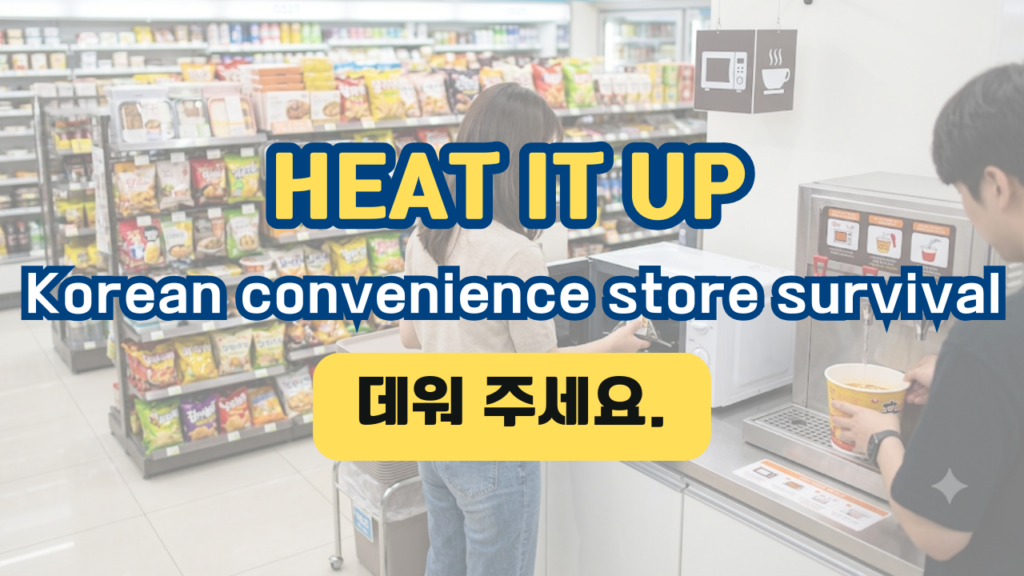
What makes them special is that they’re built for eating right there. Most have a microwave and a hot-water dispenser, plus a little counter or seats by the window. You can buy a triangle kimbap (삼각김밥), a cup of instant noodles (컵라면), and a banana milk, heat everything up, and have a hot meal for a few thousand won without leaving the store. Once you understand this, the Korean convenience store stops being a snack stop and becomes your cheapest, most reliable meal option in the country.
How to Heat Up Your Food
This is the skill Lena was missing. When you buy something that should be warm — kimbap, a lunchbox (도시락), a bun — you have two options.
At many stores there’s a self-service microwave (전자레인지, jeon-ja-re-in-ji) near the hot-water station. You unwrap what needs unwrapping, pop it in, and heat it yourself. Lunchboxes usually have suggested heating times printed on the label.
If you’d rather the staff do it, or you’re not sure, just hand it over and say:
- Please heat it up → 데워주세요 (de-wo-ju-se-yo)
- Can I heat this up? → 이거 데워도 돼요? (i-geo de-wo-do dwae-yo?)
- Where’s the microwave? → 전자레인지 어디 있어요? (jeon-ja-re-in-ji eo-di i-sseo-yo?)
For instant noodles, fill the cup to the line at the hot-water dispenser (온수기, on-su-gi), wait a few minutes, and eat it right at the counter. It’s a genuine rite of passage — I still do it more than I should.
The “Do You Need a Bag?” Moment
Here’s the question that catches almost every visitor at checkout: the cashier will ask “봉투 필요하세요?” (bong-tu pi-ryo-ha-se-yo? — “Do you need a bag?”).
The reason it exists: plastic bags are no longer free in Korea. Because of environmental regulations, convenience stores charge a small fee for a bag, usually around 50–100 won, and many push reusable options. So when you hear that question, you just answer:
- Yes, please → 네, 봉투 주세요 (ne, bong-tu ju-se-yo)
- No, it’s okay → 아니요, 괜찮아요 (a-ni-yo, gwaen-chan-a-yo)
If you’re only buying a drink or two, most locals just wave it off and carry the items out by hand. Bringing your own small bag or tote is very normal here.
How to Actually Save Money (The Part Tourists Miss)
This is where the Korean convenience store rewards people who know the system — and where Lena was quietly overpaying.
1+1 and 2+1 events. Look for shelf tags marked 1+1 (원 플러스 원) or 2+1. “1+1” means buy one, get one free; “2+1” means buy two, get the third free. These rotate constantly, especially on drinks, snacks, and ice cream. If a tag says 1+1, take the second one — you’re not paying extra for it. My honest habit: I often choose what to buy based on what’s on 1+1 that week.
Telecom membership discounts. This is the big one nobody tells visitors. If you’re staying long enough to have a Korean phone plan (SKT, KT, or LG U+), your telecom membership (통신사 멤버십) gives instant discounts at convenience stores. At checkout, ask:
- Does the telecom membership discount apply? → 통신사 멤버십 할인 돼요? (tong-sin-sa membership hal-in dwae-yo?)
Chain point apps. CU and GS25 each have their own membership and app (GS25’s is “더팝 / The Pop”), and they tie into broader point systems. To collect points, say “적립해 주세요” (jeok-rip-hae ju-se-yo — “please add my points”) and show the barcode. Points add up faster than you’d expect if the store is part of your daily routine.
A Real Checkout Conversation
Here’s the whole interaction, start to finish, so nothing surprises you:
Staff: 봉투 필요하세요? (Do you need a bag?)
You: 아니요, 괜찮아요. (No, it’s okay.)
You: 통신사 멤버십 할인 돼요? (Does the telecom discount apply?)
Staff: 네, 바코드 보여주세요. (Yes, show me the barcode.)
You: 이거 데워주세요. (Please heat this up.)
Four lines, and you’ve handled the bag, the discount, and the heating like you’ve done it a hundred times. And, as everywhere in Korea, there’s no tipping — the screen total is what you pay.
Mistakes I See Foreign Friends Make
Not heating food that’s meant to be hot. Kimbap and lunchboxes are so much better warm. Use the microwave — it’s there for you.
Paying full price during a 1+1 event. If the tag says 1+1 and you grab only one, you’re literally leaving a free item behind.
Never asking about telecom discounts. Long-term visitors with a Korean plan can save on nearly every visit and usually have no idea.
Panicking at “봉투 필요하세요?” Now you know it’s just the bag question. Yes or no — that’s all.
FAQ
Can I eat inside a Korean convenience store?
Yes — most have a counter or seats plus a microwave and hot-water dispenser. Eating a cup-noodle-and-kimbap meal in-store is completely normal and very common.
Why isn’t my bag free?
Plastic bags are paid in Korea due to environmental rules, usually 50–100 won. Bring your own small bag if you want to skip the charge.
Do I need an app to get discounts?
Not for 1+1 events — those apply to everyone automatically. For point collection and some deals, the chain’s app or your telecom membership helps.
What’s the cheapest way to eat here?
Combine a 1+1 drink, a triangle kimbap, and instant noodles heated in-store. It’s one of the best-value hot meals in the country.
The Bottom Line
Once you can heat your own food, answer the bag question, and stack 1+1 deals with a telecom discount, the Korean convenience store transforms from a snack stop into your cheapest daily ally. It fits right alongside knowing how to order coffee like a local and how to order food delivery — the three pillars of feeding yourself in Korea without stress. Lena now heats her own kimbap and hunts for 1+1 tags like a pro. After this, so will you.
고구마

댓글 0
첫 댓글을 남겨보세요.