
Korean Street Food Guide: What to Order & How
Every few days I do a supply run to the market for the restaurant, and I have never once made it out without stopping at the same 떡볶이 cart near the entrance. The ajumma who runs it has been feeding me since before I opened my own place — she still slips an extra piece of 순대 into my cup without asking. That cart is my whole argument for this Korean street food guide: Street food is one of the easiest ways for a first-time visitor to try everyday Korean food without navigating a full restaurant menu
What to Try First
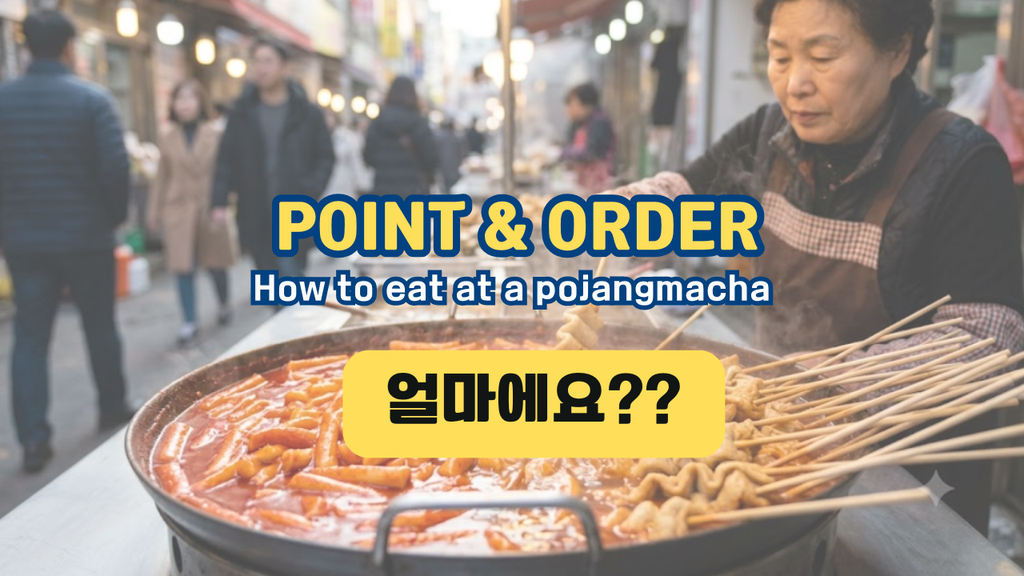
Street food (길거리 음식) is cheap, fast, and everywhere — markets, subway exits, busy shopping streets. Here’s what I’d point a first-timer toward:
- 떡볶이 (tteokbokki) — chewy rice cakes in a sweet-spicy sauce, the undisputed king of Korean street food
- 어묵 / 오뎅 (eomuk) — fish cakes on skewers in warm broth; the broth is often free and self-serve
- 순대 (sundae) — Korean blood sausage, savory and rich
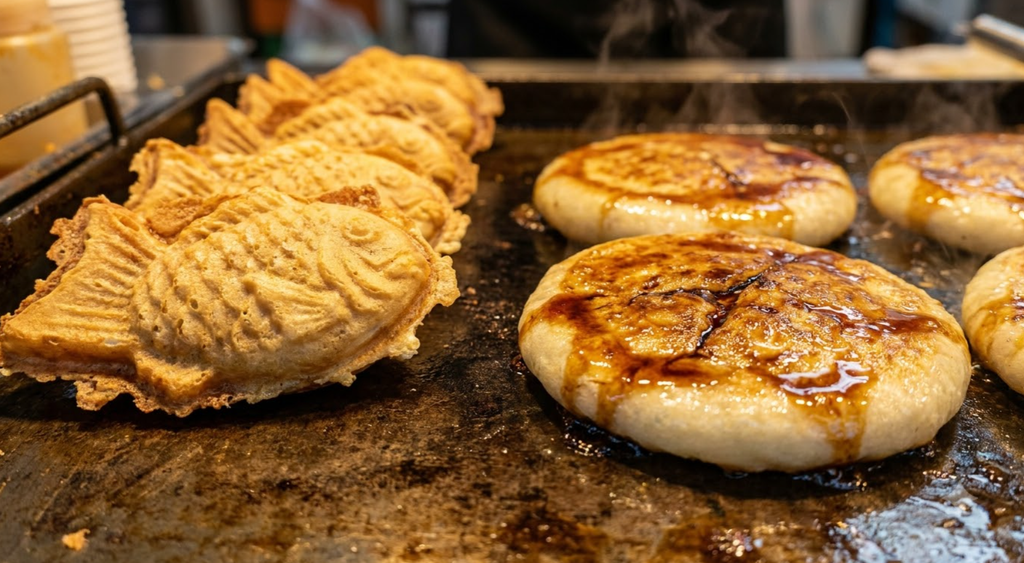
- 붕어빵 (bungeoppang) — fish-shaped pastries filled with sweet red bean, a winter staple
- 호떡 (hotteok) — a griddled pancake oozing brown sugar syrup
- 닭꼬치 (dak-kkochi) — grilled chicken skewers, often glazed and a little spicy
- 계란빵 (gyeran-ppang) — a small bread baked with a whole egg inside
If you only try one thing, make it tteokbokki with a side of eomuk broth to cool the heat. If you’ve got a sweet tooth, a winter hotteok is pure comfort.
How Ordering Actually Works
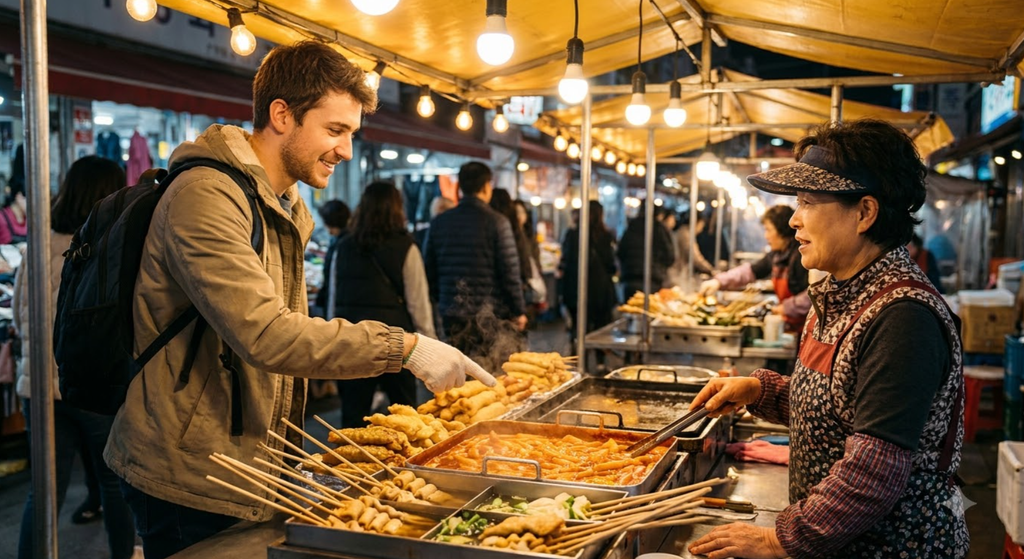
This is the easy part, and it’s why street food is such a confidence booster. Most carts have everything on display, so you rarely need full sentences — you point and name a quantity:
- One of these, please → 이거 하나 주세요 (i-geo ha-na ju-se-yo)
- One portion of tteokbokki → 떡볶이 일 인분 주세요 (tteok-bok-ki il-in-bun ju-se-yo)
- How much is it? → 얼마예요? (eol-ma-ye-yo?)
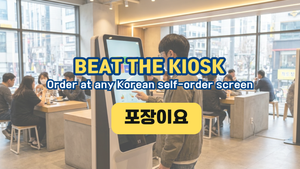
- To go, please → 포장이요 (po-jang-i-yo)
- More broth, please → 국물 더 주세요 (guk-mul deo ju-se-yo)
Point at what you want, say “이거 하나 주세요,” and you’re eating within a minute.
A Couple of Practical Tips
Carry a little cash. Many carts now take cards or mobile pay, but the smallest, oldest stalls sometimes prefer cash — a few small bills save you an awkward moment.
Eat where you buy. At most stalls you eat right there, standing at the cart, dipping skewers back into the shared broth pot. Take your rice-cake cup, grab a toothpick for the fish cake, and join the little crowd of people eating shoulder to shoulder. That’s the whole experience.
Chase it down at a market. For the full spread, head to a traditional market like Gwangjang in Seoul, where entire alleys are lined with stalls. It’s street food turned into a feast.
I’ve eaten in nice restaurants all over this city, and I still think that market cart makes the best afternoon snack in Seoul. Street food doesn’t ask much of you — a couple thousand won, a point of the finger, and a willingness to eat standing up. Do that, and you’ve unlocked one of the most genuine tastes of daily Korean life.
고구마

댓글 0
첫 댓글을 남겨보세요.