
How to Order at a Korean Pub (Anju & Drinks Guide)
After we lock up the restaurant for the night, my cooks and I usually spill into a little 포차 (pocha) down the alley in Mapo. The first time a new hire from the Philippines joined us, he tried to order just a beer — no food — and the owner blinked at him like he’d asked for a glass of water at a wedding. That moment captures the single most important thing about how to order at a Korean pub: here, you don’t just drink. You drink with food. Once you understand that, the rest falls into place quickly, and a Korean pub night becomes one of the warmest things you’ll do here.
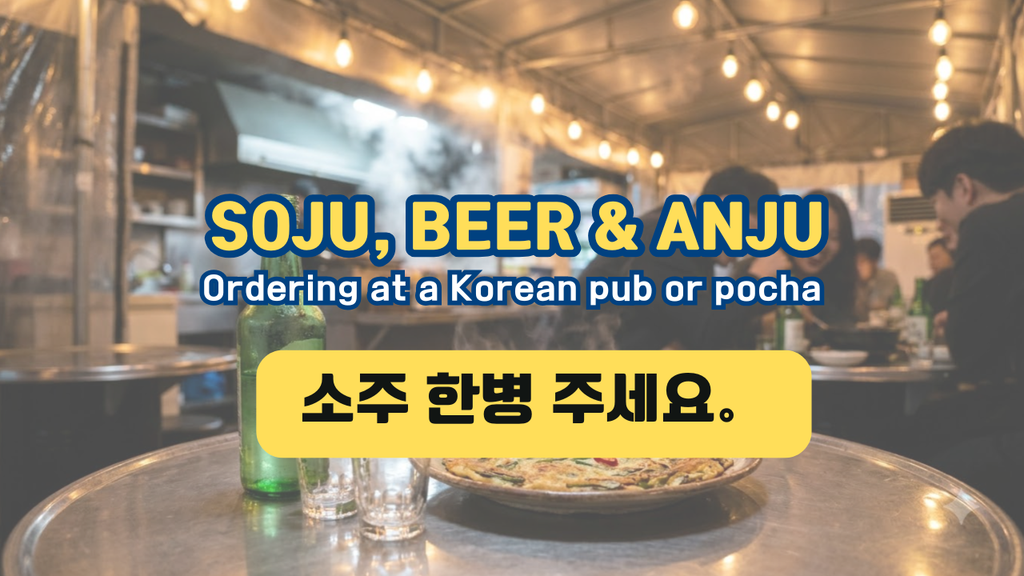
First, Understand Anju
The concept that trips up every newcomer is 안주 (anju) — food eaten specifically alongside alcohol. At many Korean pubs and pocha-style restaurants, drinks are commonly ordered with anju, although some places also allow drinks without food. A table orders a bottle or two, plus a shared plate (or three) of anju, and everyone picks at it through the night.
So when you sit down, expect to order both. Some popular anju to know:
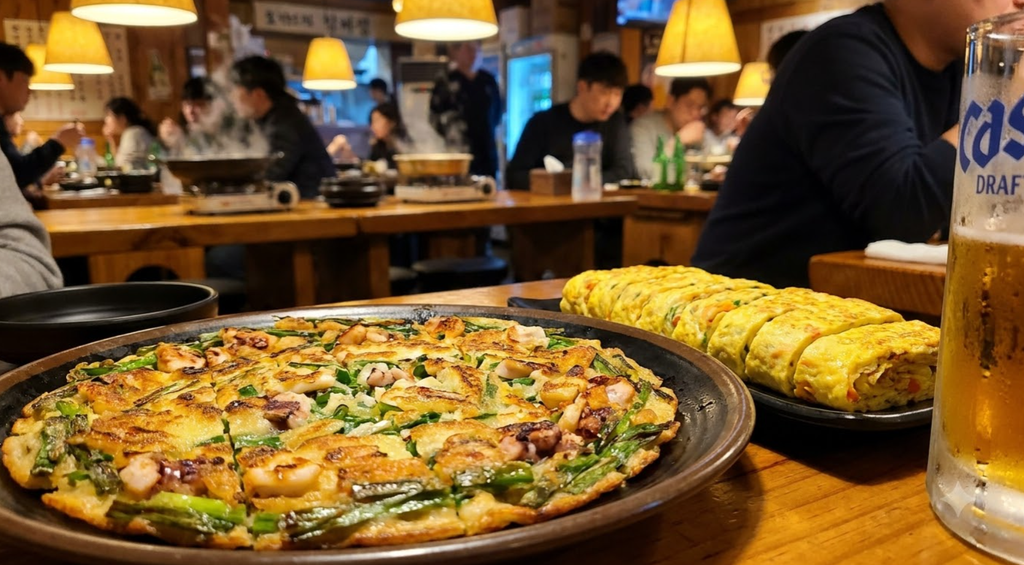
- 파전 (pajeon) — savory scallion pancake, unbeatable on a rainy night
- 골뱅이무침 (golbaengi-muchim) — spicy sea snails with noodles
- 계란말이 (gyeran-mal-i) — rolled omelette, mild and comforting
- 치킨 (chi-kin) — fried chicken, the eternal beer partner
- 마른안주 (mareun-anju) — dried snacks (squid, nuts) for lighter grazing
If you’re unsure, just ask the staff to recommend one — that’s completely normal.
The Drinks You’ll See
- 소주 (soju) — the clear, sharp national spirit, sold by the bottle
- 맥주 (maekju) — beer, often 생맥주 (saeng-maekju, draft)
- 소맥 (somaek) — a soju-and-beer mix, a Korean institution
- 막걸리 (makgeolli) — cloudy rice wine, milky and lightly sweet, great with pajeon
The Phrases to Order
- Please recommend an anju → 안주 추천해 주세요 (an-ju chu-cheon-hae ju-se-yo)
- One bottle of soju, please → 소주 한 병 주세요 (so-ju han byeong ju-se-yo)
- Two draft beers, please → 생맥주 두 잔 주세요 (saeng-maek-ju du jan ju-se-yo)
- One more bottle, please → 한 병 더 주세요 (han byeong deo ju-se-yo)
To call the staff, the same rules as any Korean spot apply: a clear “여기요!” or, at a casual pocha, a friendly “이모!” (auntie) or “사장님!” (boss).
A Few Etiquette Touches
Korean drinking has its own gentle choreography, and following it makes you instantly welcome. I’ll keep it to the essentials here:
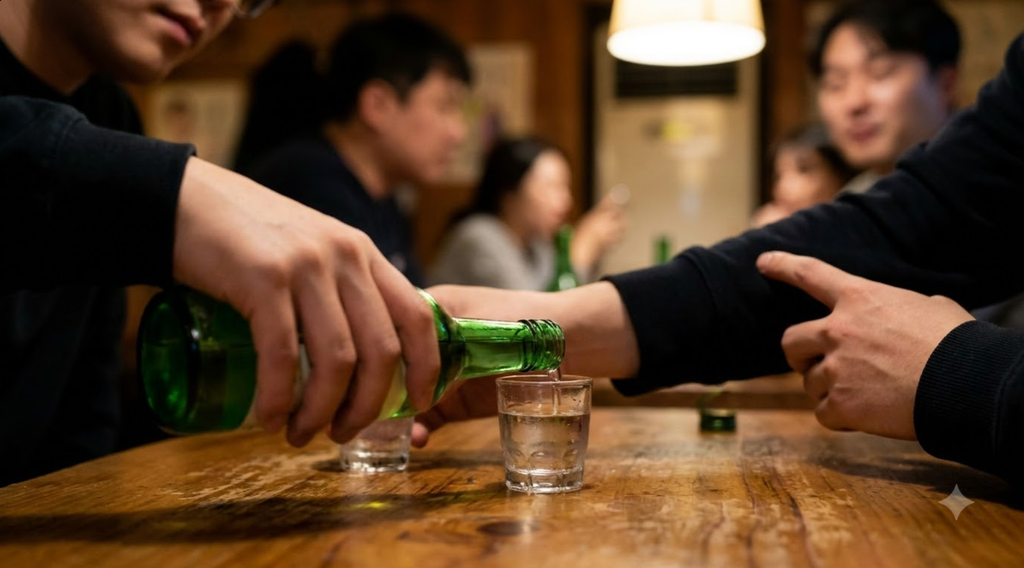
- Pour for others, not yourself. Keep an eye on your companions’ glasses and refill them; someone will refill yours.
- Use two hands when pouring for, or receiving from, someone older — one hand on the bottle, the other supporting your wrist.
- Turn slightly away when taking a drink in front of an elder, as a small sign of respect.
- Say 짠! (jjan!) — “cheers!” — before the first sip.
That’s enough to look thoughtful rather than clueless. When my new hire started pouring for everyone else before himself, the whole table warmed to him immediately.
Rounds and the Long Night
Korean drinking often moves in rounds (차) — 1차 at the pub, maybe 2차 somewhere else, occasionally a 3차. There’s no obligation to survive all of them; slipping away between rounds is normal and easy. And of course, since there’s no tipping anywhere in Korea, you simply split the total — which is where knowing how to divide the bill earns its keep.
That new cook of mine? He’s now the one who insists we order the golbaengi, and he pours for the whole table without being told. A Korean pub isn’t really about the alcohol — it’s about the shared plate in the middle and the people around it. Order some anju, keep everyone’s glass full, and you’re already part of it.
고구마

댓글 0
첫 댓글을 남겨보세요.