
How to Order Food Delivery in Korea (Baemin Guide)
One rainy night, my friend Daniel was staying at my place and wanted to order fried chicken, so he grabbed my phone, opened the delivery app — and immediately handed it right back, defeated by a wall of Korean. That’s the moment most visitors hit, and it’s exactly why learning how to order food delivery in Korea is worth ten minutes of your time. Korea has arguably the most convenient food delivery culture on earth: hot food at your door in 30–40 minutes, at almost any hour. As a Korean who orders delivery more often than I’d like to admit, let me show you how the apps really work, and the little request phrases that make you look like you’ve lived here for years.
The Delivery Apps You’ll Actually Use
Korea runs on a few major delivery apps, and it helps to know the names before you download anything.
배달의민족 (Baedal Minjok), usually just called 배민 (Baemin), is one of Korea’s major food-delivery platforms, alongside services such as Coupang Eats and Yogiyo. The other two you’ll hear about are 쿠팡이츠 (Coupang Eats) and 요기요 (Yogiyo). For most people, Baemin plus Coupang Eats covers everything.
Here’s the honest catch for visitors: these apps are built primarily in Korean, and they typically need a Korean phone number and a local payment method to work smoothly. That’s the real barrier — not the ordering itself, but the sign-up. If you’re staying long-term with a Korean number and card, you’re golden. If you’re visiting short-term, this is often where friends ask a local to place the order for them, which is completely normal.
How the Ordering Flow Works
Once you’re in, the flow is refreshingly logical:
- Set your address. The app delivers based on your registered location, so pin it accurately — down to the building and unit.
- Browse by category or search. Chicken, jjajangmyeon, pizza, cafe desserts — it’s all there, sorted by category and rating.
- Watch two numbers. Each restaurant shows a 최소주문금액 (minimum order amount) and a 배달비 (delivery fee). Delivery fees have climbed in recent years and vary by distance and time, so it’s normal to see a few thousand won added on.
- Add items, then hit the request box — this is the part that matters most, so it gets its own section.
- Pay in-app and track the rider on a live map until they reach your door.
Decoding the Request Box (요청사항)
When you check out, the app gives you a text field called 요청사항 (yo-cheong-sa-hang) — “requests.” There are usually two: one for the restaurant (about the food) and one for the rider (about delivery). This little box is where locals quietly customize everything. Here are the phrases worth copying and pasting.
To the rider (delivery requests)
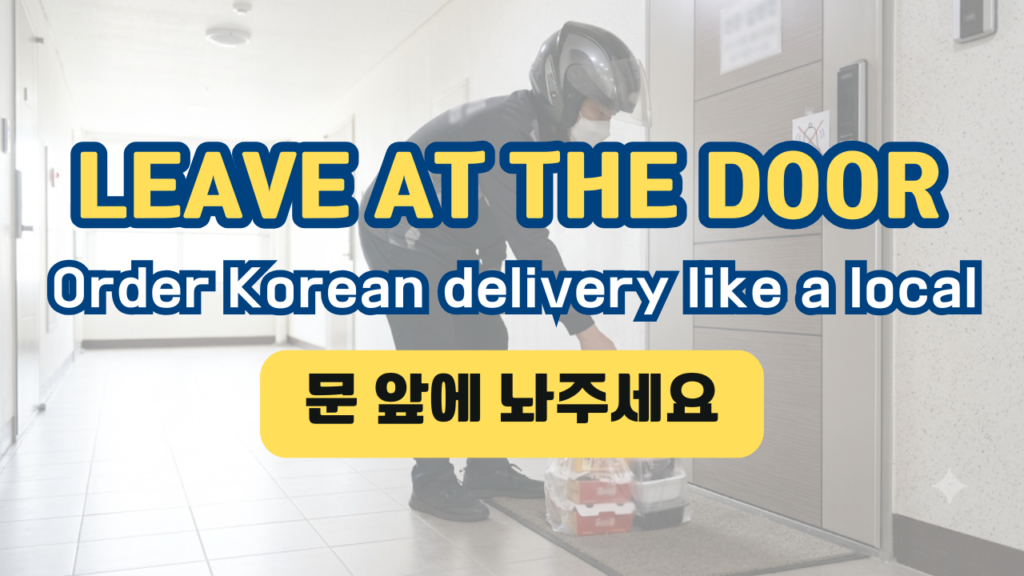
- Leave it at the door → 문 앞에 놔주세요 (mun ap-e nwa-ju-se-yo)
- Don’t ring the bell → 벨 누르지 마세요 (bel nu-reu-ji ma-se-yo)
- Call me when you arrive → 도착하면 전화 주세요 (do-chak-ha-myeon jeon-hwa ju-se-yo)
To the restaurant (food requests)
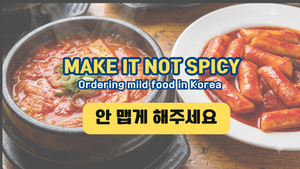
- Make it not spicy → 안 맵게 해주세요 (an maep-ge hae-ju-se-yo)
- Please include disposable cutlery → 일회용 수저 주세요 (il-hoe-yong su-jeo ju-se-yo)
- No cutlery needed → 수저 안 주셔도 돼요 (su-jeo an ju-syeo-do dwae-yo)
That cutlery line deserves a note, because it surprises everyone. Since an environmental rule change a few years ago, Korean delivery apps now default to NOT sending disposable spoons and chopsticks — you have to actively check a box or type a request if you want them. My foreign friends are always baffled when their food arrives with nothing to eat it with. If you don’t have utensils at home, ask for them explicitly.
The Very Korean “Review Event” (리뷰 이벤트)
Here’s a piece of delivery culture you won’t find in any phrasebook. Many restaurants run a 리뷰 이벤트 (review event): order something, promise to leave a review, and they’ll toss in a freebie — extra cheese balls, a soda, an extra portion of pickled radish, sometimes a whole side dish.
To join, you write something like “리뷰 이벤트 참여할게요 (ri-byu i-ben-teu cham-yeo-hal-ge-yo — I’ll join the review event)” in the request box, or select it if the restaurant lists it as a menu option. After the food arrives, you post a photo and a short review, and everyone’s happy.
I’ll be honest about the nuance here: this system has been criticized because it nudges people toward inflated five-star reviews, so take glowing ratings with a grain of salt. But as a customer, it’s a genuinely nice way to get a little extra for free. Just actually leave the review — the small restaurant owner really is watching.
A Real Request Box, Filled Out Like a Local
To make it concrete, here’s what my actual request box often looks like when I order chicken on a rainy night:
- To the restaurant: 일회용 수저 주세요. 리뷰 이벤트 참여할게요. (Please include cutlery. I’ll join the review event.)
- To the rider: 문 앞에 놔주세요. 벨 누르지 마세요. (Leave it at the door. Don’t ring the bell.)
Four short lines, and the entire experience is customized. Copy those, and you’ll look completely fluent in delivery.
Mistakes I See Foreign Friends Make
Expecting cutlery by default. It won’t come unless you ask. Learn “일회용 수저 주세요.”
Ignoring the minimum order amount. If you’re ordering solo, you may not hit the 최소주문금액. That’s part of why splitting a big order with friends is so common here.
Vague addresses. Riders rely on an exact unit and building. A fuzzy address means a phone call in Korean you may not want. Pin it precisely and add a landmark in the rider request if needed.
Skipping the request box entirely. This is where all the good customization lives — no bell, food at the door, free review-event snacks. Don’t leave it blank.
FAQ
Can I use food delivery apps in Korea without a Korean phone number?
Usually not smoothly — most apps expect a Korean number and local payment for sign-up. Short-term visitors often have a local friend place the order, or use hotel/guesthouse delivery help.
Are the apps available in English?
They’re built mainly for Korean users. Some have added partial English, but coverage is inconsistent, so the request phrases above are genuinely useful even when the interface is translated.
Why did my food arrive with no spoon or chopsticks?
Because Korean apps now default to no disposable cutlery for environmental reasons. You have to request it every time.
Is the delivery fee normal?
Yes — a separate 배달비 on top of the food is standard now, and it grows with distance and peak-time demand. It’s not a scam; it’s just how pricing works here.
The Bottom Line
Once you understand the request box, the no-cutlery default, and the review-event freebies, you’ve basically mastered how to order food delivery in Korea — the single most convenient thing about daily life here. It slots right in with knowing how to order your coffee like a local and how to split the bill with friends; together they cover eating and drinking across Korea without a hint of hesitation. Daniel eventually got his fried chicken that night — I placed the order — but with these phrases, you won’t have to hand the phone back.
고구마

댓글 0
첫 댓글을 남겨보세요.