
Your First Order Coffee in Korea (Less Ice, Extra Shot)
The first time I took my friend Emma to a Mega Coffee near my apartment in Seoul, she froze at the counter, pointed at a random photo on the menu, and ended up with a drink so sweet she couldn’t finish half of it. That was the moment I realized that knowing how to order coffee in Korea is a tiny survival skill nobody actually teaches you. As a Korean who has lived in Seoul my whole life — and dragged more visiting friends into cafes than I can count — I’ve watched that same little moment of panic happen again and again. So let me save you from Emma’s mistake and walk you through it the way I would for a friend standing next to me.

Why Ordering Coffee in Korea Feels Different
Before the phrases, it helps to understand why the experience trips people up. It’s not the language — it’s the system.
First, coffee here is shockingly cheap at the big franchises. Chains like Mega Coffee (메가커피) and Compose Coffee (컴포즈커피) sell an iced americano for somewhere around 1,500–2,000 won — often cheaper than a bottle of water. These places are everywhere, and they move fast, so the counter interaction is quick and to the point.
Second, Koreans are genuinely obsessed with iced coffee. There’s even a slang word for it: 얼죽아 (eol-juk-a), short for “얼어 죽어도 아이스 아메리카노” — “an iced americano even if I freeze to death.” I have friends who order iced coffee in the middle of a snowstorm without blinking. So if you just say “coffee,” don’t be surprised when the default assumption leans iced.
Third, there’s a rule most visitors don’t know about: since a 2018 environmental regulation, cafes can’t serve drinks in disposable cups if you’re staying inside. That’s why the staff will almost always ask whether you’re drinking in or taking out — dine-in gets a real mug or glass, takeout gets the plastic cup. That single question catches a lot of my foreign friends off guard.
The Essential Phrases for Ordering Coffee in Korea
Here’s the toolkit. Each phrase is written in Korean, then a rough pronunciation, then what it does. You only need three or four of these to sound completely at ease.
Temperature
- Iced → 아이스로 주세요 (a-i-seu-ro ju-se-yo) — “Iced, please.”
- Hot → 따뜻한 걸로 주세요 (tta-tteu-tan geol-lo ju-se-yo) — “The hot one, please.”
Ice control (this is the big one)
- Less ice → 얼음 적게 주세요 (eol-eum jeok-ge ju-se-yo) — “Less ice, please.”
- No ice → 얼음 빼주세요 (eol-eum ppae-ju-se-yo) — “No ice, please.”
Syrup / sweetness
- Less syrup → 시럽 조금만 넣어주세요 (si-reop jo-geum-man neo-eo-ju-se-yo) — “Just a little syrup, please.”
- No syrup → 시럽 빼주세요 (si-reop ppae-ju-se-yo) — “No syrup, please.”
Strength
- Extra shot → 샷 추가해주세요 (syat chu-ga-hae-ju-se-yo) — “Add an extra shot, please.”
Size & destination
- The bigger size → 큰 걸로 주세요 (keun geol-lo ju-se-yo) — “The large, please.”
- For here → 여기서 먹고 갈게요 (yeo-gi-seo meok-go gal-ge-yo) — “I’ll drink it here.”
- To go → 포장이요 (po-jang-i-yo) — “To go.”
A quick note on ice, because this is the mistake I see most: a Korean iced americano can be aggressively icy — sometimes the cup is 70% ice. If you want to actually taste your coffee, “얼음 적게 주세요” is the single most useful thing you can learn today.
A Real Cafe Conversation, Start to Finish
Textbook phrases are one thing; the actual rhythm of the counter is another. Here’s a realistic exchange at a place like Mega Coffee, so you know what’s coming.
Staff: 주문 도와드릴게요. (I’ll take your order.)
You: 아이스 아메리카노 하나 주세요. (One iced americano, please.)
You: 얼음 적게 주세요. (Less ice, please.)
Staff: 매장에서 드세요? (Are you drinking here?)
You: 아니요, 포장이요. (No, to go.)
Staff: 카드 주세요. (Card, please.)
That’s the whole thing. Notice the staff asking “매장에서 드세요?” — that’s the dine-in-versus-takeout question from earlier. Just answer “여기서요” (here) or “포장이요” (to go) and you’re done. Payment is commonly made by card or phone, and tipping is generally not expected in everyday cafes in Korea. The price on the screen is exactly what you pay.
Ordering at a Kiosk (When There’s No Staff)
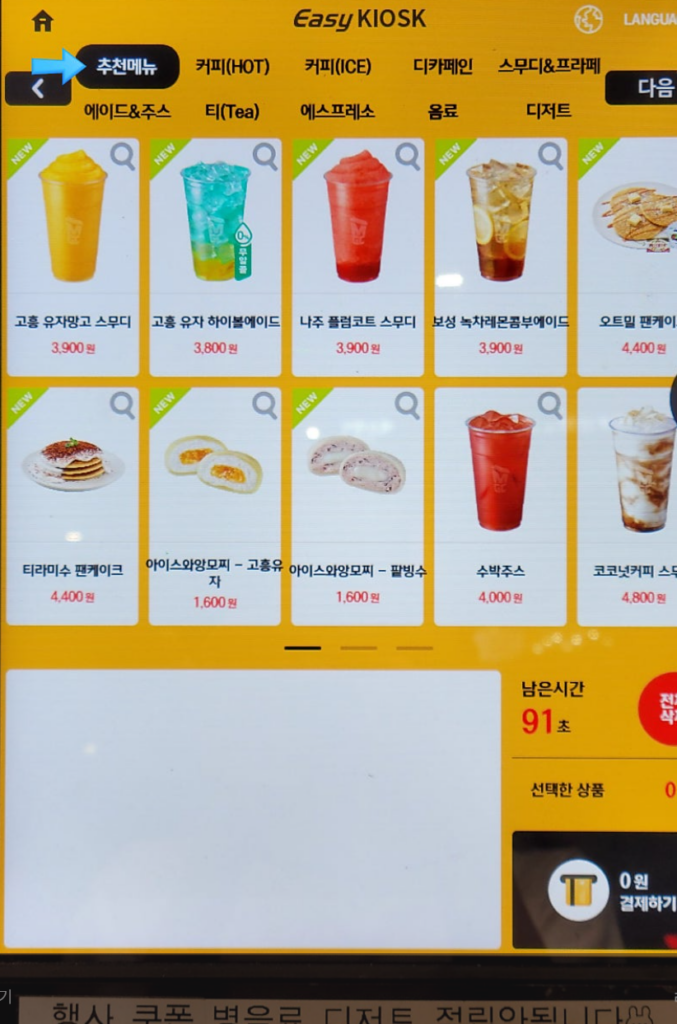
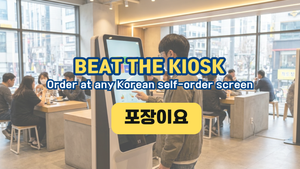
More and more franchises, especially smaller Mega and Compose branches, run on self-order kiosks. This actually works in your favor, because many kiosks have an English button in the corner. Here’s the flow I always show first-timers:
- Tap the language button (look for “ENG” or a globe icon) if you want English.
- Pick your drink, then choose HOT or ICED.
- Look for an “options” or “옵션” step — this is where you can add an extra shot or adjust syrup.
- Choose 매장 (for here) or 포장 / 테이크아웃 (to go).
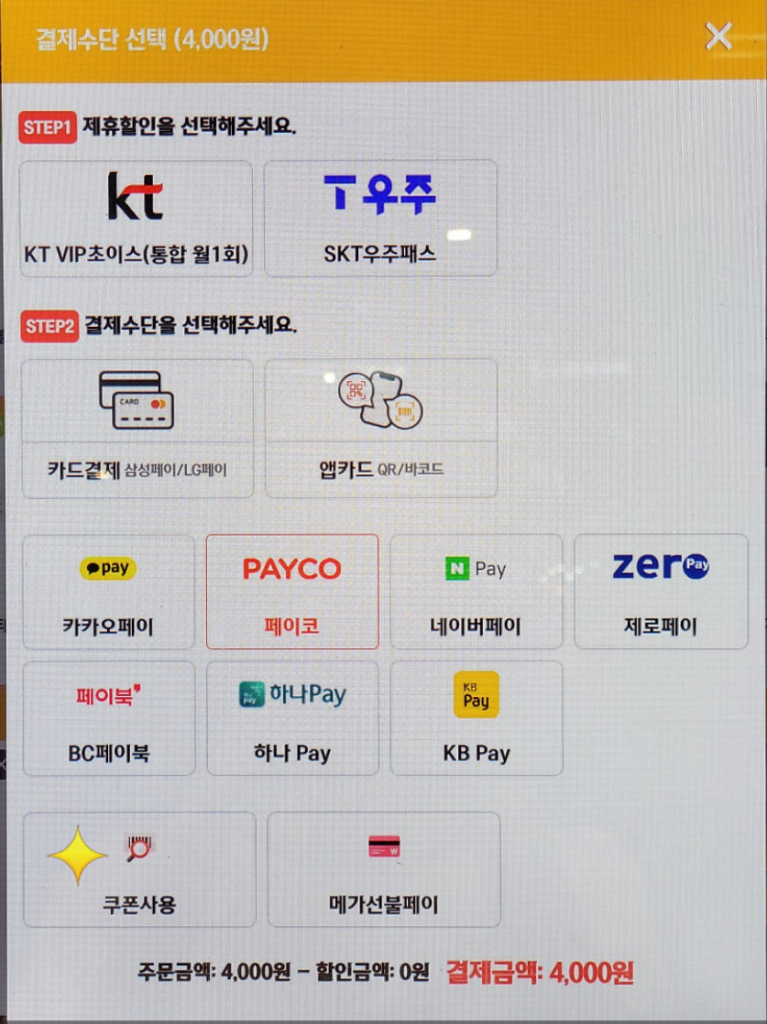
- Pay by card or phone at the machine, take your receipt, and wait for your number.
The one thing kiosks often don’t let you customize easily is “less ice.” If that matters to you, order at the kiosk but add a quick “얼음 적게 주세요” to the staff when you pick up. They’ll sort it out.
Mistakes I See Foreign Friends Make
I’ve watched enough cafe runs to know exactly where things go sideways.
The sweetness ambush. Drinks with a flavor name — vanilla, hazelnut, anything “-latte” — are often much sweeter here than back home. If you’re sensitive to sugar, default to an americano or add “시럽 조금만.”
The iceberg cup. Forgetting to ask for less ice and then being annoyed that your 2,000-won americano is mostly frozen water. Learn the ice phrase first.
Freezing on the dine-in question. When staff ask “매장에서 드세요?”, a lot of visitors panic because they didn’t expect a question at all. Now you know it’s coming — just say here or to go.
Assuming small cafes take English. The big franchises and their kiosks usually manage fine, but a tiny independent cafe run by one older owner may not. That’s exactly when these Korean phrases turn a stressful moment into a smooth one.
FAQ
Do baristas in Korea speak English?
At major franchises in tourist-heavy areas, often enough to get by, and their kiosks usually have an English mode. At small neighborhood cafes, less reliably — which is why a few memorized phrases go a long way.
Is coffee in Korea really that cheap?
At budget chains like Mega Coffee and Compose, yes — an americano frequently lands around 1,500–2,000 won. Specialty and dessert cafes cost more, closer to what you’d expect in a Western city.
Can I pay with a foreign card or my phone?
Card payment is standard almost everywhere, and contactless is common. Some foreign cards and mobile wallets work smoothly; it’s still smart to carry a backup card, and a little cash for the smallest independent shops.
How do I ask for decaf or oat milk?
Ask “디카페인 있어요?” (di-ka-pe-in i-sseo-yo? — “Do you have decaf?”) or “오트밀크로 변경돼요?” (o-teu-mil-keu-ro byeon-gyeong-dwae-yo? — “Can I switch to oat milk?”). Availability varies by chain, so it’s genuinely a question, not a given.
Final Sip
Once you can handle the temperature, the ice, and the “here or to go?” question, you basically know how to order coffee in Korea like someone who lives here. It’s a small thing, but there’s a real quiet confidence in walking up to a counter in Seoul, ordering your iced americano with less ice, and answering the dine-in question without missing a beat. Emma can do it now without pointing at photos — and after this, so can you.
고구마

댓글 0
첫 댓글을 남겨보세요.