
Seoul Subway Guide for Foreigners (T-money & Transfers)
One of my part-timers, a student from Vietnam, once got hit with penalty fares for weeks without realizing it — she was tapping her card to enter the subway but forgetting to tap out on the way off. When she finally asked me why her balance kept vanishing, it clicked instantly. That little tap-out habit is exactly the kind of thing no one tells you, which is why this Seoul subway guide for foreigners exists. The Seoul Metro is widely used in Seoul and offers extensive coverage, frequent service, and English signs at many stations. and once you learn a few basics, it’ll take you almost anywhere. As a Seoul local who rides it constantly, let me get you fluent in it.
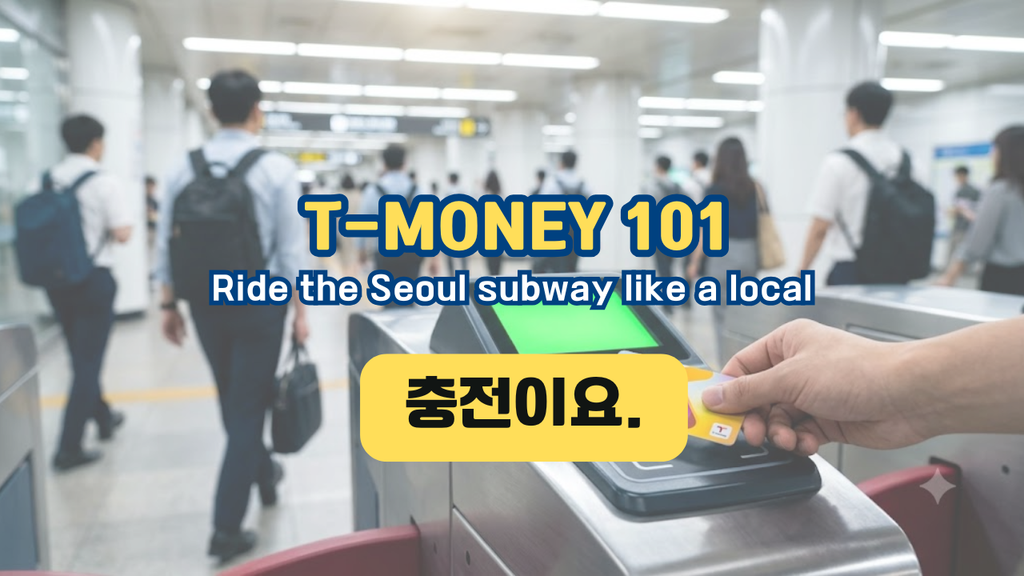
Why the Seoul Subway Is So Easy to Love
Let’s start with the good news: the system is built for newcomers. Stations and signs are labeled in English as well as Korean, announcements are made in multiple languages, and every line has both a number and a color, so you can navigate largely by matching colors. It’s fast, it runs frequently, and it’s remarkably affordable.
The two things that actually trip foreigners up aren’t the trains — they’re the payment card and the transfer system. Nail those two, and you’re set.
Step 1: Get and Charge a T-money Card
The heart of it all is 티머니 (T-money) — a rechargeable transit card you tap to ride. Here’s how it works:
- Buy one at any convenience store (CU, GS25, 7-Eleven, emart24) or from machines in the station. It’s cheap and reusable.
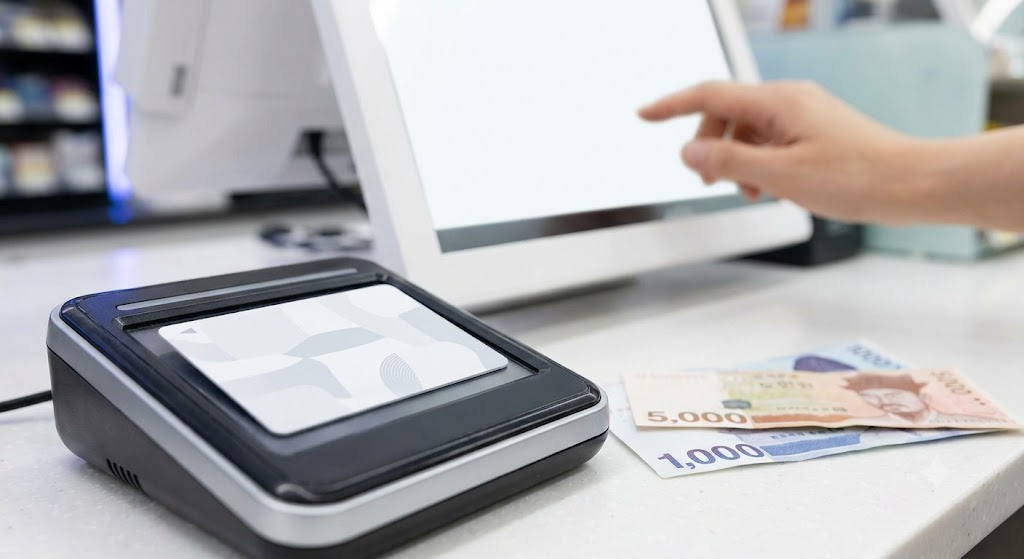
- Charge it (충전, chung-jeon) with cash at convenience stores, or at the top-up machines inside stations (which have an English menu).
- Tap and ride — one card covers subway and city buses.
To charge it at a convenience store, hand the clerk your card and say:
- Please charge my transit card → 교통카드 충전해 주세요 (gyo-tong-ka-deu chung-jeon-hae ju-se-yo)
- Or simply → 충전이요 (chung-jeon-i-yo) — “top-up, please.”
The clerk will ask how much: “얼마 충전해 드릴까요?” (how much would you like?). Just say the amount — “만 원이요” (10,000 won) is a common start.
There are alternatives worth knowing: the 기후동행카드 (Climate Card) offers unlimited Seoul transit for a monthly price if you’re staying a while, and tourist options like WOWPASS bundle transit with a prepaid card. But for most people, a simple T-money is all you need.
Step 2: Always Tap In AND Tap Out
This is the lesson my part-timer learned the hard way. You tap your card on the way in and again on the way out. Fares are distance-based, so the system needs both taps to calculate the correct amount.
Forget to tap out, and you get penalized — the system assumes you rode to the end of the line and may charge a penalty, or refuse your next entry. So make it a reflex: tap in, tap out, every single time. A base ride is inexpensive — in the mid-1,000-won range with T-money, raised periodically — so there’s no reason to risk a penalty.
Step 3: Master the Free Transfer (환승)
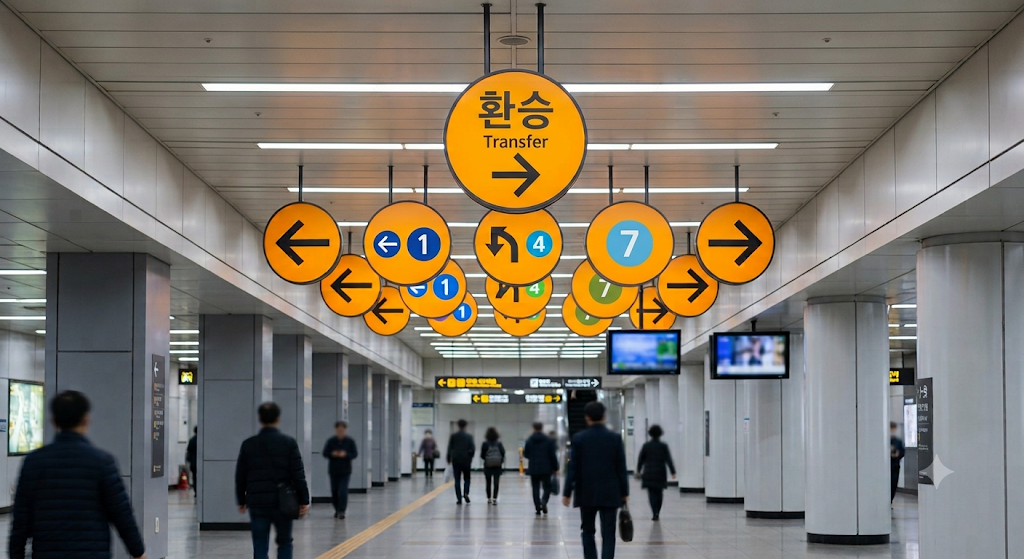
Here’s the feature that makes the system brilliant: 환승 (hwan-seung), the transfer. When you switch lines — or even switch between subway and bus — you get a free or discounted transfer, as long as you use the same T-money card and tap correctly.
- Between subway lines, just follow the orange 환승 (transfer) signs within the station; you don’t exit or pay again.
- Between subway and bus, tap your card as you board the bus, and the discount applies automatically — because you tapped out of the subway first. (Yet another reason to always tap out.)
This transfer system can turn a subway-plus-bus journey into barely more than a single fare. It’s one of the best deals in the city.
Finding Your Way: Use the Right App
A crucial tip: for navigation in Korea, use Naver Map (네이버 지도) or KakaoMap (카카오맵), not the map app you use back home — foreign map apps are often unreliable for Korean transit directions. Naver and Kakao will give you exact lines, transfer points, platform numbers, and even which subway car to board for the fastest exit. Both have English options.
The Phrases That Help
Most of the ride is silent and sign-guided, but these come in handy:
- Which line is it? → 몇 호선이에요? (myeot ho-seon-i-e-yo?)
- Is this the right direction? → 이 방향 맞아요? (i bang-hyang ma-ja-yo?)
- Where’s the exit? → 출구 어디예요? (chul-gu eo-di-ye-yo?)
Stations are marked with numbered exits (출구), and knowing your exit number saves a lot of wandering — Naver Map usually tells you the best one.
A Quick Etiquette Note
One thing locals take seriously: the priority seats (노약자석) at the ends of each car are reserved for the elderly, pregnant, and disabled. Even if they’re empty and the train is packed, most Koreans leave them free. Following that custom marks you as considerate — and I promise someone is always noticing.
FAQ
What card do I need for the Seoul subway?
A T-money card — buy it at any convenience store, charge it with cash, and tap to ride both subway and buses. It’s the simplest option for most people.
Do I really need to tap out?
Yes. Fares are distance-based, so you tap in and out every ride. Forgetting to tap out can trigger a penalty fare.
How do transfers work?
Use the same T-money card and you get a free or discounted transfer between lines, and between subway and bus, within the time limit — just follow the 환승 signs.
Which map app should I use in Korea?
Naver Map or KakaoMap. Foreign map apps are unreliable for Korean transit; the local apps give accurate lines, transfers, and exits in English.
The Bottom Line
Once you’ve got a T-money card, the tap-in-tap-out reflex, and the free 환승 transfer down, this Seoul subway guide for foreigners basically pays for itself in saved fares and saved stress. Charge your card with a quick “충전이요,” always tap out, and let Naver Map plot your route. It works hand in hand with knowing how to call a Kakao Taxi for the last stretch and how to grab a Ttareungi bike for short hops — together they cover getting anywhere in Seoul. My part-timer now taps out on pure autopilot. After this, so will you.
고구마



댓글 0
첫 댓글을 남겨보세요.