
What ‘Let’s Eat Sometime’ Means in Korea (밥 한번 먹자)
When my friend David first started making Korean friends, he got genuinely excited every time someone said “let’s eat sometime” as they parted — and then quietly confused when the meal never actually happened. After the fourth or fifth time, he asked me, half-hurt, “Do Koreans just not follow through?” That’s the misunderstanding I want to clear up, because learning what “let’s eat sometime” in Korea really means will save you a lot of unnecessary disappointment. The phrase — 밥 한번 먹자 (bap han-beon meok-ja) — is one of the most common things you’ll hear, and most of the time it isn’t a plan at all. As a Korean who says it myself more than I realize, let me explain what’s actually going on.
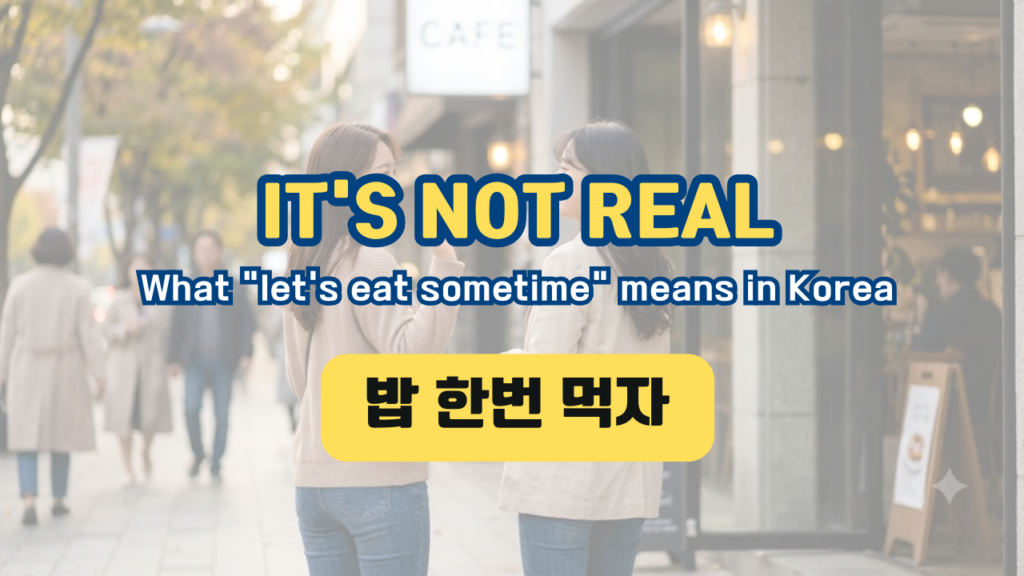
What the Phrase Literally Means vs. What It Actually Means
Literally, 밥 한번 먹자 translates to “let’s eat a meal once” — an invitation to share food. But in practice, it usually functions as a warm social closer, much closer to the English “we should catch up sometime” than to an actual dinner plan.
Koreans say it at the end of a conversation, when running into someone, or when wrapping up a meeting — as a friendly way to signal goodwill. It means “I like you, I feel warm toward you, and I’m open to spending time together.” What it very often does not mean is “check your calendar, we’re setting a date.” David was treating a friendly pleasantry as a firm commitment, and that mismatch is what left him confused.
Why Koreans Say It (Even When They Don’t Mean a Specific Plan)
This makes more sense once you understand the cultural logic behind it. Korean communication leans warm and relationship-oriented, and it tends to prize keeping a pleasant, connected feeling over stating things bluntly.
Ending an interaction with 밥 한번 먹자 does emotional work: it leaves the relationship on an open, affectionate note without the pressure of actual logistics. Saying a flat “okay, bye” can feel a little cold; adding “let’s eat sometime” softens the goodbye and keeps the door warmly ajar. It’s less a scheduling statement and more a small gift of warmth. Once you see it that way, it stops feeling like a broken promise and starts feeling like what it is — kindness.

How to Tell If It’s Real or Just Polite
Here’s the practical part David needed. The difference between a genuine invitation and a friendly pleasantry usually comes down to one thing: specificity.
It’s probably just polite if:
- It’s vague and floats by as they’re leaving — “밥 한번 먹자~” with no follow-up.
- There’s no mention of when, where, or any next step.
- It’s said in passing to a larger group.
It’s probably real if they add a concrete step, like:
- “이번 주말에 시간 돼?” (Are you free this weekend?)
- “언제가 좋아?” (When works for you?)
- “날짜 잡자.” (Let’s set a date. — nal-jja jab-ja)
The magic signal is a move toward the calendar. Vague warmth is a pleasantry; a specific time is a plan. If someone genuinely wants to eat with you, they’ll almost always follow the phrase with a concrete question.
How to Respond (Both Ways)
The beauty is that you can play it either direction, gracefully.
If you’re happy to keep it as friendly warmth, just mirror it back:
- Yes, let’s do that! → 네, 좋아요! (ne, jo-a-yo!)
- Sure, sometime! → 그래요, 언제 한번! (geu-rae-yo, eon-je han-beon!)
No commitment implied, everyone feels good.
If you actually want to make it happen, gently pin it down — this is completely acceptable and even appreciated:
- When works for you? → 언제가 좋아요? (eon-je-ga jo-a-yo?)
- Shall we set a date? → 날짜 잡을까요? (nal-jja ja-beul-kka-yo?)
By adding specificity yourself, you convert the pleasantry into a real plan. I’ve had plenty of friendships deepen exactly because someone was brave enough to answer “밥 한번 먹자” with “좋아요, 언제가 좋아요?”

Other Warm Pleasantries You’ll Hear
밥 한번 먹자 has cousins that work the same way — warm closers rather than firm plans:
- 커피 한잔 하자 (keo-pi han-jan ha-ja) — “let’s grab a coffee”
- 조만간 봐요 (jo-man-gan bwa-yo) — “let’s see each other soon-ish”
- 언제 술 한잔 하자 (eon-je sul han-jan ha-ja) — “let’s grab a drink sometime”
Treat all of these the same way: lovely to hear, genuinely kind, and real only when a specific time gets attached.
A Quick Contrast
Same phrase, two very different meanings:
Just polite:
A: 오늘 재밌었어! 밥 한번 먹자~ (Today was fun! Let’s eat sometime~)
B: 응, 좋아! (Yeah, sounds good!) — and it lives as warmth.
Actually a plan:
A: 밥 한번 먹자. 이번 주 목요일 어때? (Let’s eat. How about this Thursday?)
B: 목요일 좋아! (Thursday works!) — now it’s on the calendar.
Same four words up front; the follow-up tells you everything.
FAQ
Does “밥 한번 먹자” mean Koreans are being fake?
Not at all — it’s genuine warmth, just not a scheduling statement. Think of it like “we should catch up sometime” in English: sincere in feeling, loose on logistics.
How do I know if someone really wants to eat with me?
Look for specificity. If they suggest a day or ask when you’re free, it’s real. If it’s vague and floats by, it’s a friendly closer.
Is it rude to pin down a vague invitation?
No — it’s often welcomed. Answering with “언제가 좋아요?” shows genuine interest and can turn a pleasantry into a real friendship.
What should I say if I just want to be polite back?
“네, 좋아요!” or “언제 한번!” mirrors the warmth without committing to anything specific.
The Bottom Line
Once you understand that “let’s eat sometime” in Korea — 밥 한번 먹자 — is usually a warm goodbye rather than a dinner plan, you’ll stop feeling let down and start hearing it for the kindness it is. Watch for specificity to spot the real invitations, and don’t be shy about pinning one down when you want to. And when the meal does happen, you’ll be glad you know how to split the bill gracefully and how banchan refills work. David eventually learned to ask “언제가 좋아요?” — and now he actually gets the dinners. After this, so will you.
고구마





댓글 0
첫 댓글을 남겨보세요.