
Parking Validation in Korea: How to Ask for Discounts
The first time my friend Tom rented a car in Korea, he parked at a mall, had a great afternoon, and then stared in disbelief at the exit gate demanding a fee he didn’t understand — because nobody told him he could have gotten most of it waived for free. That moment is why I wanted to explain parking validation in Korea properly. The system here is genuinely convenient once you get it: cameras read your plate automatically, and a quick word at the cafe or store counter can knock hours off your bill. As a Korean who drives around Seoul constantly and has rescued a few panicking friends at exit gates, let me walk you through exactly how it works.
How Parking Actually Works in Korea
Two features make Korean parking different from what many visitors expect, and understanding them changes everything.
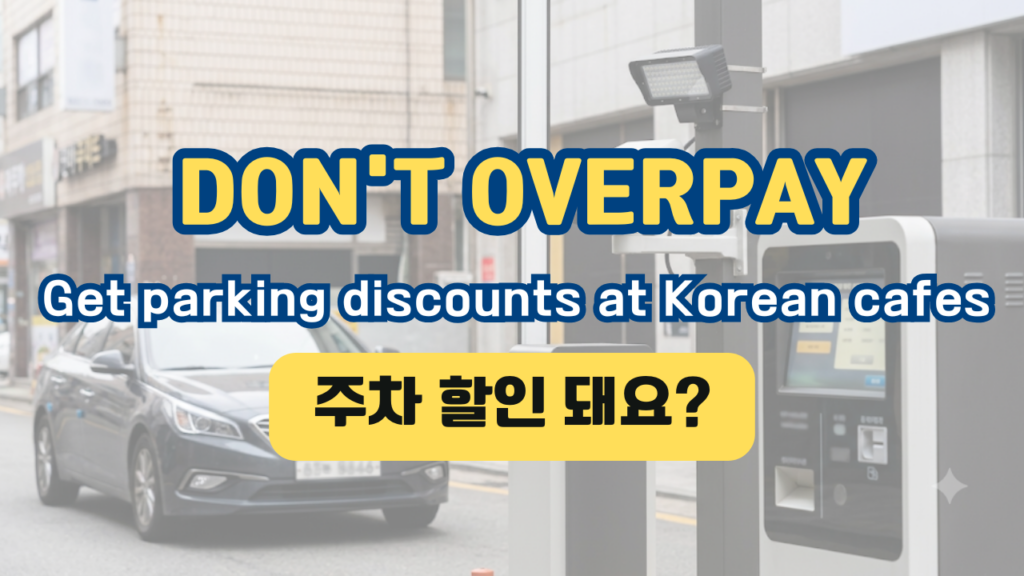
First, most lots use automatic license plate recognition (LPR). You simply drive in — a camera photographs your plate — and there’s often no ticket to pull. The system already knows when you arrived. When you leave, the exit gate calculates your fee automatically, or you settle it just before at a payment machine.
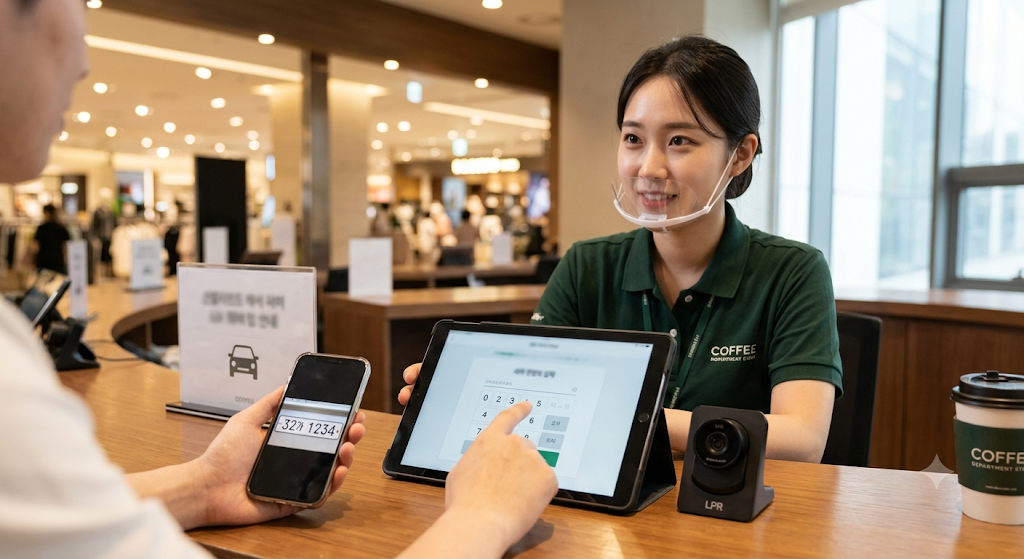
Second, and this is the money-saver: Some cafes, restaurants, malls, and department stores offer free or discounted parking when you make a purchase, but the conditions vary by location. Buy a coffee, get an hour or two validated. The catch is that it isn’t automatic — you have to ask the staff to register your car, usually by giving them your plate number. Tom didn’t know to ask, so he paid full price for parking he could have had for the cost of a latte.
The Key Vocabulary: Validation vs. Settlement
Two words carry this whole topic, so learn the difference:
- 주차 등록 (ju-cha deung-nok) = parking registration/validation — what the store does to your plate to give you the free time.
- 주차 정산 (ju-cha jeong-san) = parking settlement — actually paying the (remaining) fee, usually at a machine or the exit.
So the flow is: the store 등록s your car, and then you 정산 whatever’s left, if anything.
The Phrases You Need
Here’s the toolkit — Korean, rough pronunciation, meaning.
At the cafe or store counter
- Please register my parking → 주차 등록해 주세요 (ju-cha deung-nok-hae ju-se-yo)
- Do you offer parking discounts? → 주차 할인 돼요? (ju-cha hal-in dwae-yo?)
- Is parking free? → 주차 무료예요? (ju-cha mu-ryo-ye-yo?)
- How many hours are free? → 몇 시간 무료예요? (myeot si-gan mu-ryo-ye-yo?)
Giving your plate number
- My car number is… → 차 번호 …예요 (cha beon-ho …ye-yo)
At the payment machine or exit
- Where do I pay for parking? → 주차 정산 어디서 해요? (ju-cha jeong-san eo-di-seo hae-yo?)
- How much is the overtime charge? → 초과요금 얼마예요? (cho-gwa-yo-geum eol-ma-ye-yo?)
The single most useful habit: the moment you buy something at a place with a parking lot, ask “주차 등록해 주세요” and be ready to read out your plate number. That one sentence is what Tom was missing.
Giving Your Plate Number
When you ask for validation, the clerk will almost always ask for your plate number so they can enter it into their tablet or machine. They’ll say something like:
- What’s your car number? → 차량 번호 몇 번이세요? (cha-ryang beon-ho myeot beon-i-se-yo?)
Korean plates are a mix of numbers and one Korean character (like 12가3456). You can read the digits in English and just point to or sound out the middle character — clerks do this with foreigners all the time, so don’t stress about pronouncing it perfectly. Snap a photo of your plate on your phone when you park; showing the picture is the easiest workaround.
A Real Parking Conversation
Here’s how it flows at, say, a cafe with a parking lot:
You: 주차 등록해 주세요. (Please register my parking.)
Clerk: 차량 번호 몇 번이세요? (What’s your plate number?)
You: 12가 3456이요. (It’s 12-ga-3456.)
Clerk: 두 시간 무료예요. (Two hours free.)
That’s it — two hours knocked off, just for buying a coffee you were going to buy anyway.
Avoiding the Overtime Charge
Validation usually covers a set block of time — often one or two hours. Stay longer and you’ll owe an overtime charge (초과요금) for the excess, calculated by the minute or in small time blocks.
To avoid a nasty surprise at the exit:
- Ask how many hours your validation covers (“몇 시간 무료예요?”).
- If you’re staying longer, note your entry time and be aware the meter runs after the free block.
- At unmanned lots, look for a payment machine (정산기) near the exit; settle there first, then drive out smoothly instead of holding up the gate.
FAQ
Is parking really free at Korean cafes and malls?
Often partially — many offer one or two hours free with a purchase. But it’s not automatic; you must ask staff to register your plate.
What if there’s no parking ticket when I drive in?
That’s normal — most lots use plate-recognition cameras instead of tickets. The system tracks your entry automatically and you pay based on your plate.
How do I tell them my plate number if I can’t read the Korean character?
Read the digits in English and show a photo of your plate. Clerks handle this with foreign drivers routinely.
Where do I actually pay?
Either at the exit gate automatically, or at a payment machine (정산기) near the exit at unmanned lots. Ask “주차 정산 어디서 해요?” if you’re unsure.
The Bottom Line
Once you know to ask “주차 등록해 주세요,” have your plate number ready, and check how many free hours you’ve got, parking validation in Korea turns from a mystery fee into an easy discount. Always ask when you buy something, watch the free-time limit, and settle at the machine before the exit. It fits right alongside knowing how to order that validating coffee and how to split the bill afterward. Tom now asks for parking registration at every cafe out of habit — and hasn’t overpaid since. After this, neither will you.
고구마


댓글 0
첫 댓글을 남겨보세요.