
What ‘Geunyang’ (그냥) Really Means in Korean
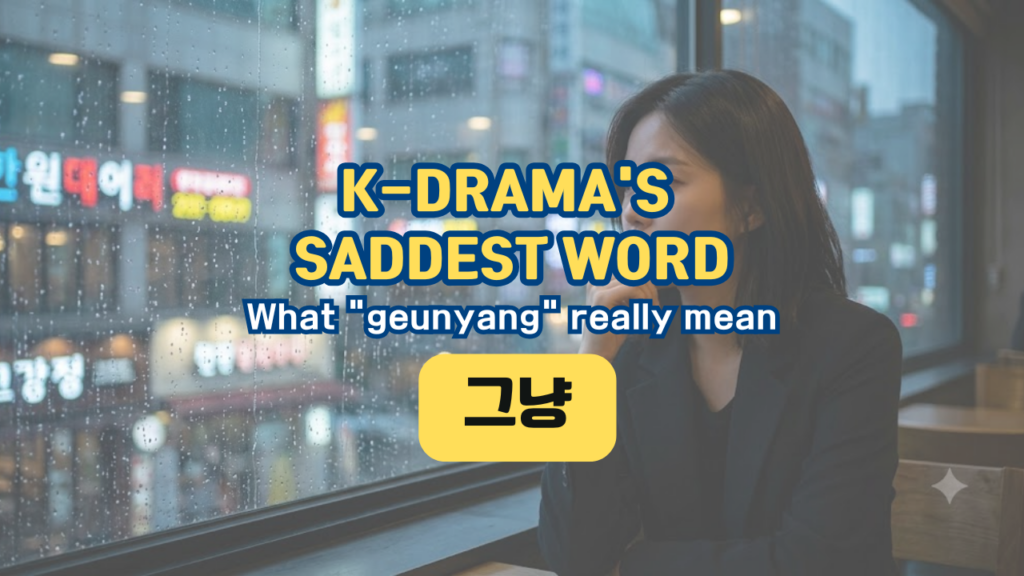
There’s a moment in almost every Korean drama where a character is asked what’s wrong, looks away, and quietly says “그냥.” The subtitle usually reads “nothing” or “no reason” — and yet any Korean viewer instantly knows it means the exact opposite: something is very much the matter. That single word is one of the most emotionally loaded in the language, and understanding the real geunyang meaning will change how you watch K-dramas and how you read real conversations here. It looks like a throwaway filler, but 그냥 is often where the actual feeling hides. As a Korean who uses it constantly, let me unpack its many layers.
The Literal Meaning
On the surface, 그냥 (geu-nyang) simply means “just,” “just because,” or “for no particular reason.” If a friend asks why you bought a certain snack and you shrug and say “그냥,” you’re saying “no special reason, just felt like it.” That’s the innocent, everyday use — and it’s genuine plenty of the time.
But 그냥 has a way of stretching far beyond that literal sense, depending on tone, context, and what’s left unsaid. Here are the layers that matter.
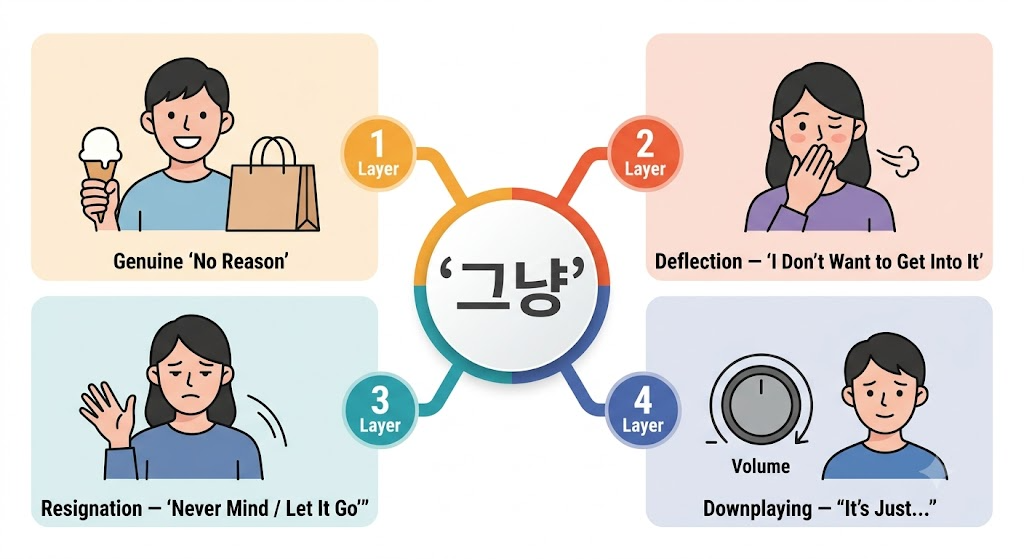
Layer 1: Genuine “No Reason”
The straightforward version. Someone asks a small “why,” and 그냥 honestly means there’s no deep reason.
- Why did you call? → 왜 전화했어?
- No reason, just because. → 그냥.
Light, casual, true. Nothing hidden here. The trick is that the same word can carry much heavier freight, which is where foreigners get misled.
Layer 2: Deflection — “I Don’t Want to Get Into It”
This is the big one, and it’s what that K-drama scene is doing. When someone says “그냥…” with a pause, a sigh, or a glance away, it usually means: there is a reason, but I don’t want to talk about it.
- What’s wrong? → 왜 그래?
- …It’s nothing. → 그냥…
Here 그냥 is a soft wall. The person is feeling something — hurt, worry, disappointment — but choosing not to unpack it, often to avoid burdening you or breaking the mood. Reading this correctly is pure nunchi: the trailing 그냥 is an invitation to gently care, not to take “no reason” at face value.
Layer 3: Resignation — “Never Mind / Let It Go”
그냥 can also carry a note of giving up, of deciding something isn’t worth pursuing.
- Just forget it. → 그냥 하지 마. (geu-nyang ha-ji ma)
- Let’s just let it go. → 그냥 넘어가자. (geu-nyang neom-eo-ga-ja)
In this mode, 그냥 means “drop it, it’s not worth the effort or the conflict.” Depending on tone, it can sound peaceful (“let’s not make a thing of it”) or quietly defeated (“I’ve stopped expecting more”). Context tells you which.
Layer 4: Downplaying — “It’s Just…”
그냥 often softens or minimizes what follows, taking the weight off a statement.
- I was just curious. → 그냥 궁금해서. (geu-nyang gung-geum-hae-seo)
- It’s just so-so. → 그냥 그래. (geu-nyang geu-rae)
“그냥 궁금해서” makes a question feel casual and non-pushy. “그냥 그래” is the classic lukewarm answer to “how are you?” — not bad, not great, just… fine. Here 그냥 is a volume knob, turning a statement down to something modest and low-key.
How to Tell Which “그냥” You’re Hearing
Since one word covers all this, you read it through context and delivery:
- Bright, quick, casual → probably the innocent “no reason” (Layer 1).
- Trailing off, a sigh, eyes away → deflection; there’s a real feeling underneath (Layer 2).
- Flat, with a dismissive wave → resignation; drop it (Layer 3).
- Attached to a full sentence (“그냥 ~해서”) → downplaying (Layer 4).
The emotional 그냥 almost always comes with a pause or a change in energy. When the word slows down, the feeling speeds up. This is the same unspoken-layer reading behind how Koreans refuse without saying no — Korean often puts the truth in the delivery, not the dictionary.
Why K-Dramas Love It
Screenwriters adore 그냥 precisely because it lets a character say “nothing” while the audience sees everything. A longing glance plus a whispered “그냥” tells you the character is in love, or grieving, or holding back tears — all without a single explicit line. Once you can feel that gap between the word and the emotion, K-dramas open up on a whole new level, and you start catching subtext that the subtitles flatten into “no reason.”
Using 그냥 Yourself
You can wield it too. Want to keep something light? “그냥 궁금해서” softens a nosy-sounding question. Don’t want to explain your mood? A gentle “그냥…” politely closes the topic. Feeling meh? “그냥 그래.” Just remember that a trailing 그냥 invites the other person to read between the lines — so use it when you want that soft, unspoken texture.

FAQ
What does 그냥 (geunyang) mean literally?
“Just,” “just because,” or “for no particular reason.” But depending on tone it can also signal deflection, resignation, or downplaying.
Why do K-drama characters always say 그냥?
Because it lets them say “nothing” while feeling everything. A pause plus 그냥 usually means there’s a real emotion they’re not voicing.
How do I know if 그냥 means “no reason” or “I don’t want to talk about it”?
Delivery. Bright and quick means genuine “no reason”; slow, trailing, or with a sigh means there’s something underneath.
Can I use 그냥 to avoid answering?
Yes — a soft “그냥…” politely signals you’d rather not explain, and Koreans will usually take the hint.
The Bottom Line
Once you grasp the real geunyang meaning — that 그냥 can be innocent “no reason,” quiet deflection, weary resignation, or gentle downplaying — you’ll read Korean conversations, and your favorite dramas, with far more depth. Listen for the pause; when 그냥 slows down, the feeling is loud. It sits right beside how Koreans say no without saying it and the hidden tone of Korean texting — all three live in the unspoken layer. Next time a character looks away and murmurs “그냥,” you won’t be fooled by the subtitle. You’ll know exactly what they mean.
고구마





댓글 0
첫 댓글을 남겨보세요.