
Asking Someone’s Age in Korea: Why It’s Not Rude
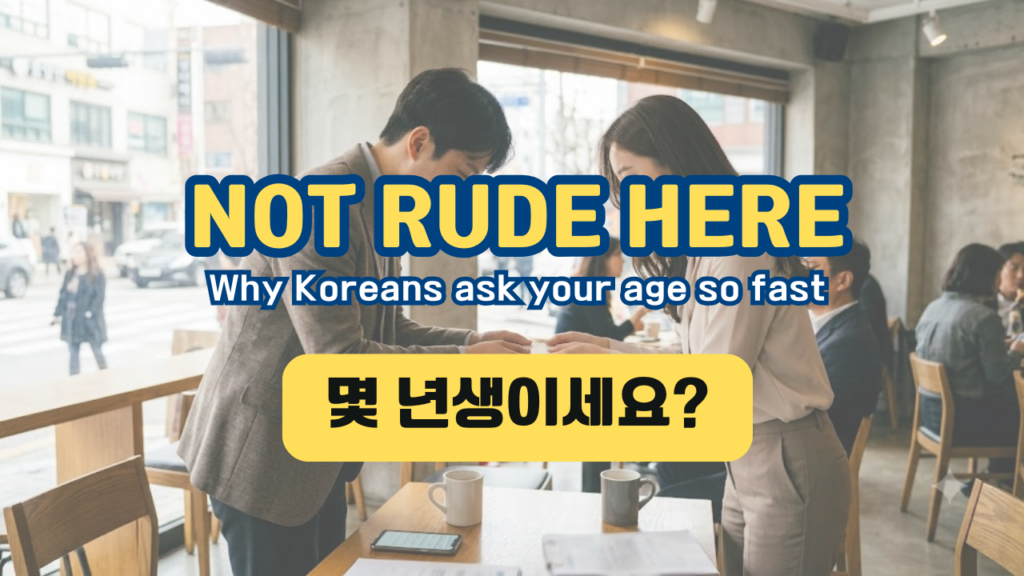
If you’ve watched even a few Korean variety shows, you’ve probably seen it: two people meet, and within about a minute someone asks what year the other was born. To many foreigners it looks startlingly direct — back home, asking a stranger’s age can feel invasive. But in Korea it’s not nosiness at all; it’s how people figure out how to talk to each other. Understanding asking someone’s age in Korea unlocks a huge part of daily social life, because age here decides your speech level and even what you call each other. As a Korean who does this reflexively with every new person, let me explain why it happens and how to handle it gracefully.
Why Age Matters So Much Here
In Korean, age can be an important factor in choosing an appropriate level of speech and forms of address, especially when meeting someone new. It determines two big things:
First, your speech level. Korean has polite speech (존댓말, jon-daen-mal) and casual speech (반말, ban-mal). You use polite speech with people older than you or those you’ve just met, and casual speech with close friends of the same age or younger — but only once it’s mutually agreed.
Second, what you call each other. Korean often replaces names with relationship titles based on relative age, which we’ll break down below. You literally can’t pick the right word for “you” until you know who’s older.
So when a Korean asks your age early, they’re not judging you — they’re trying to figure out how to be appropriately respectful. It’s a courtesy, not an intrusion.
The 2023 Age-System Change (Good News for You)
Here’s a genuinely helpful update. Korea used to have a famously confusing system where you were considered one year old at birth and everyone aged up together on New Year’s Day — the so-called “Korean age,” which could make you a year or two “older” than your international age.
As of June 2023, Korea officially standardized on international age (만 나이, man na-i) for legal and administrative purposes. So the old headache of calculating your “Korean age” is largely settled now — the official count matches the age you already know. Socially, people may still reference birth years to sort out hierarchy, but you no longer have to do confusing math.
Why Koreans Ask “몇 년생이세요?” (What Year Were You Born?)
You’ll notice Koreans often ask for your birth year rather than your age directly:
- What year were you born? → 몇 년생이세요? (myeot nyeon-saeng-i-se-yo?)
Birth year is the cleaner reference point — it pins down seniority exactly, and it feels a touch more polite than a blunt “how old are you.” Once someone knows you were born in, say, ’95 and they were born in ’93, the whole relationship structure clicks into place: who speaks politely to whom, and which title applies.
The Titles: 형, 오빠, 누나, 언니, 동생
This is the part worth memorizing, because it depends on both your gender and theirs. When addressing someone older:
- A man calls an older man 형 (hyeong) and an older woman 누나 (nuna).
- A woman calls an older man 오빠 (oppa) and an older woman 언니 (eonni).
For someone younger, either gender can refer to them as 동생 (dongsaeng) — younger one. These titles started as family words (older brother, older sister) but extend to friends, coworkers, and anyone close, which is why you hear “oppa” and “unnie” everywhere in K-dramas and K-pop.
A quick memory aid: if you’re a guy, your olders are 형/누나; if you’re a woman, your olders are 오빠/언니. Same-gender older = 형 (m) or 언니 (f); opposite-gender older = 누나 (m→f) or 오빠 (f→m).

Seniority Beyond Age: 선배 and 후배
There’s a parallel system at schools and workplaces: 선배 (seonbae) is someone senior to you there, and 후배 (hubae) is someone junior — regardless of exact age. Your 선배 gets respectful treatment even if you’re born the same year. It’s worth knowing so you don’t misjudge a hierarchy that isn’t purely about birthdate.
How to Ask Politely (and When to Wait)
You can absolutely ask, and here’s how to do it smoothly:
- Excuse me, what year were you born? → 실례지만 몇 년생이세요? (sil-lye-ji-man myeot nyeon-saeng-i-se-yo?)
Adding 실례지만 (“excuse me / if you don’t mind”) softens it nicely. A gentle note on nunchi, though: with someone clearly much older, or in a formal setting, let them lead — you’ll often just default to polite speech and titles like 선생님 without needing to ask a number at all. Peers and new acquaintances close to your age are where the birth-year question is most natural.

What Happens After You Know
Once ages are established, the relationship settles. If they’re older, you use polite speech and the right title. If you’re the same age (동갑, dong-gap), you might soon agree to drop formalities:
- Shall we speak casually? → 우리 말 놓을까요? (u-ri mal no-eul-kka-yo?)
That moment — agreeing to switch to 반말 — is a small but real milestone of closeness, a bit like the way your texting slang loosens as a friendship grows.
FAQ
Why do Koreans ask my age right away?
To know how to speak to you — age sets the speech level and the correct title. It’s a courtesy for showing proper respect, not nosiness.
Isn’t it rude to ask someone’s age?
Not in Korea, especially among peers. Softening it with “실례지만 몇 년생이세요?” makes it perfectly polite.
Do I still need to calculate “Korean age”?
Largely no. Since June 2023, Korea officially uses international age (만 나이), so the official count matches your usual age.
What’s the difference between 오빠 and 형?
Both mean “older brother,” but a woman says 오빠 to an older man, while a man says 형. The title depends on the speaker’s gender.
The Bottom Line
Once you understand that asking someone’s age in Korea is really about setting speech levels and titles, the “몇 년생이세요?” question stops feeling intrusive and starts making perfect sense. Learn the 형·오빠·누나·언니 map, lean on 실례지만 to ask politely, and enjoy the moment you agree to speak casually. It connects directly to knowing how formality shapes Korean texting and how Koreans soften what they say — age is the hidden setting behind all of it. That variety-show reflex of asking birth year? After this, you’ll understand exactly why they do it — and be ready when someone asks you.
고구마





댓글 0
첫 댓글을 남겨보세요.