
Recycling in Korea: A Foreigner’s Guide to Trash Sorting
Running a restaurant in Seoul, I deal with more trash sorting than almost anyone I know — so I’ve had a front-row seat to how genuinely overwhelmed newly arrived foreign friends get by it. One even confessed she’d been quietly stuffing everything into a single bag for a month, terrified of doing it wrong. I get it: recycling in Korea is stricter than almost anywhere on earth, and getting it wrong can even mean a fine. But there’s a simple logic underneath, and once you see it, the whole system clicks. As a Seoul local who sorts trash every single day, let me walk you through it so you never stress about it again.
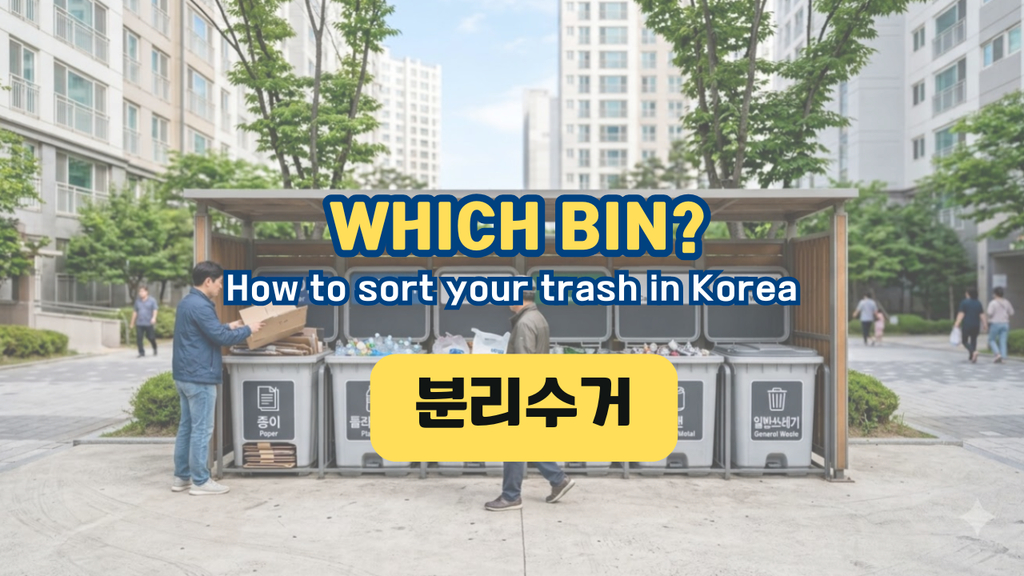
Why Korea Takes Trash So Seriously
Waste separation is required in Korea, but the specific sorting and disposal rules can vary by municipality and building. It feels intense at first, but the country recycles at impressively high rates because of it.
The key is to stop thinking of “trash” as one thing. Here, waste splits into three main streams: general waste, food waste, and recyclables. Learn those three, and you’re 90% of the way there.
Stream 1: General Waste and the Volume-Rate Bag
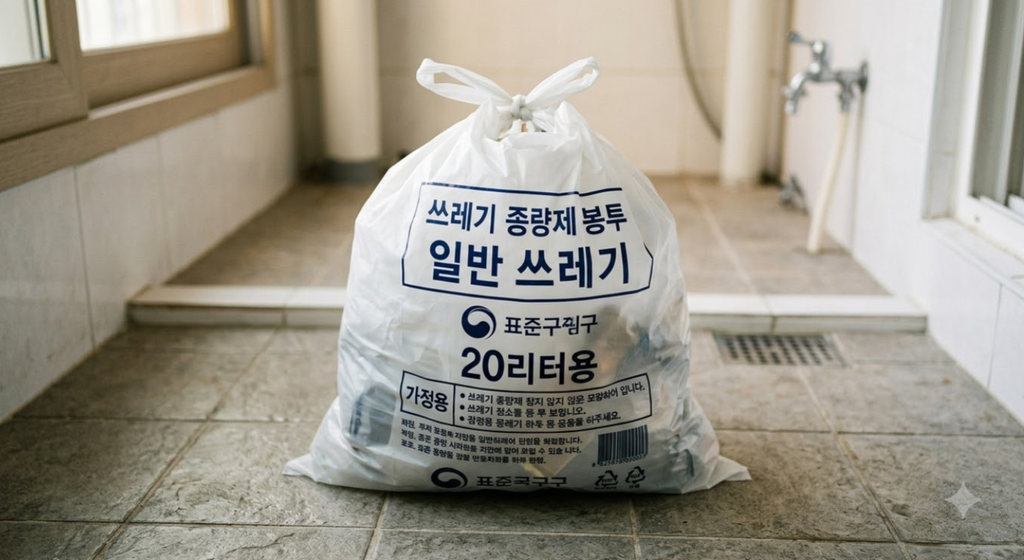
This is the rule that surprises everyone. For general (non-recyclable, non-food) waste, you can’t just use any bag — you must buy your district’s official volume-rate trash bag (종량제 봉투, jong-nyang-je bong-tu).
- These bags are specific to your district (구, gu) — a Gangnam bag won’t work in Mapo. Using the wrong district’s bag (or a regular bag) is how people get fined.
- Buy them at any convenience store or supermarket near you; they automatically stock the local one.
- They come in different liter sizes, so you pick what fits your household.
To buy one, tell the clerk:
- Please give me a volume-rate trash bag → 종량제 봉투 주세요 (jong-nyang-je bong-tu ju-se-yo)
They’ll ask what size: “몇 리터짜리 드릴까요?” (which liter size?). A common answer is “20리터요” (20 liters). This is the same counter where you’d pick up other daily essentials, so it’s an easy habit to build.
Stream 2: Food Waste (음식물 쓰레기)
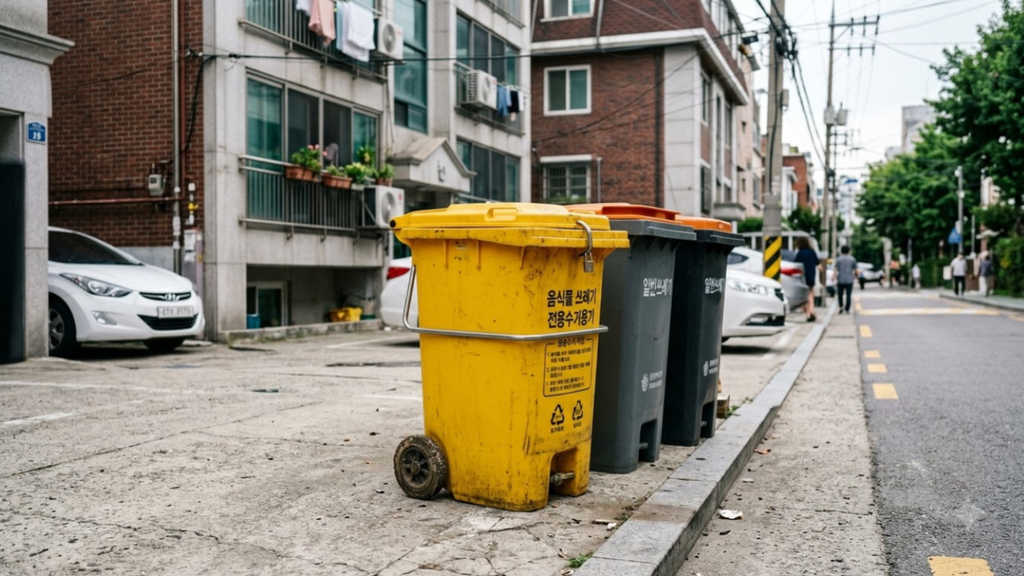
Food scraps go separately from general trash — this is the stream foreigners forget most. 음식물 쓰레기 (eum-sik-mul sseu-re-gi), food waste, is collected on its own:
- Some areas use special food-waste bags; many apartment complexes have a dedicated food-waste bin, sometimes an RFID one where you tap a card and pay by weight.
- Keep it to actual food scraps. Things like large bones, shells, and eggshells often don’t count as food waste and go in general trash instead — rules vary by district, so check locally.
Drain excess liquid before tossing it; food waste is weighed or measured, so soggy waste literally costs more.
Stream 3: Recyclables (재활용)
Recyclables (재활용, jae-hwal-yong) are sorted into categories rather than dumped together:
- Paper, plastic, glass, cans, PET bottles, and vinyl/plastic film each have their own bin or bag.
- Rinse containers and remove food residue — a greasy pizza box or unwashed yogurt cup can get rejected.
- Flatten boxes, and separate caps/labels where required.
In apartments, there’s usually a designated collection area with labeled bins, and sometimes specific days for putting recyclables out. In houses and villas, you’ll set them out by category on collection nights. All those delivery containers you’ll accumulate? Rinse them and sort them here.
Big Items: The Sticker System
For large items like furniture or appliances (대형 폐기물), you can’t just leave them out. You buy a disposal sticker (스티커) — from your district office or its website — attach it to the item, and put it out on the right day. Dumping big items without a sticker is another finable move.
The Phrases That Help
- Please give me a trash bag → 종량제 봉투 주세요 (jong-nyang-je bong-tu ju-se-yo)
- How do I sort the recycling? → 분리수거 어떻게 해요? (bun-li-su-geo eo-tteo-ke hae-yo?)
- Where do I throw this away? → 이거 어디에 버려요? (i-geo eo-di-e beo-ryeo-yo?)
That last one — “이거 어디에 버려요?” — is your safety net. When in doubt, ask a neighbor or building manager; Koreans are used to helping newcomers figure this out.
FAQ
Why can’t I use a normal trash bag in Korea?
General waste must go in your district’s official volume-rate bag (종량제 봉투). Using a regular or wrong-district bag can lead to a fine. Buy the correct one at any local convenience store.
What counts as food waste?
Actual food scraps. Items like large bones and eggshells often go in general trash instead, and rules vary by district — so check your local guidelines.
Do I really have to rinse recyclables?
Yes. Containers with food residue can be rejected. Rinse them, flatten boxes, and sort by material.
How do I throw away furniture?
Buy a disposal sticker (스티커) from your district office or its website, attach it, and put the item out on the designated day.
The Bottom Line
Once you grasp the three streams of recycling in Korea — general waste in a 종량제 봉투, food waste on its own, and rinsed recyclables sorted by type — the system that once felt terrifying becomes second nature. Buy the right bag with “종량제 봉투 주세요,” ask “이거 어디에 버려요?” when unsure, and you’ll fit right in. It pairs naturally with knowing where to buy those bags and daily essentials and how to handle all that delivery packaging. That friend who hid everything in one bag? She sorts like a pro now. After this, so will you.
고구마


댓글 0
첫 댓글을 남겨보세요.