
Banmal vs Jondaetmal: Casual vs Polite Korean
A friend who runs a team in Seoul once told me the fastest way a new hire loses points isn’t a bad idea in a meeting — it’s dropping into casual speech with a senior colleague too soon. It instantly reads as presumptuous, even when the person meant to sound friendly. That trap is exactly why every learner needs to understand banmal vs jondaetmal — the casual and polite registers of Korean. Using the wrong one can accidentally sound rude or, on the flip side, needlessly cold. As a Korean who shifts between these all day at work and with friends, let me make the rules clear and practical.

The Basics: Two Registers
Korean speech splits broadly into two:
- 존댓말 (jondaetmal) — polite, respectful speech. Your safe default with anyone older, senior, new, or in any formal or customer-facing setting.
- 반말 (banmal) — casual, informal speech. Reserved for close friends, people clearly younger than you, family, and only-after-it’s-agreed peers.
The single most important rule for a newcomer: when in doubt, use 존댓말. Using polite speech is generally a safe choice when you are unsure of the appropriate level of formality, while casual speech can be inappropriate in some situations. My friend’s new hire had that backwards.
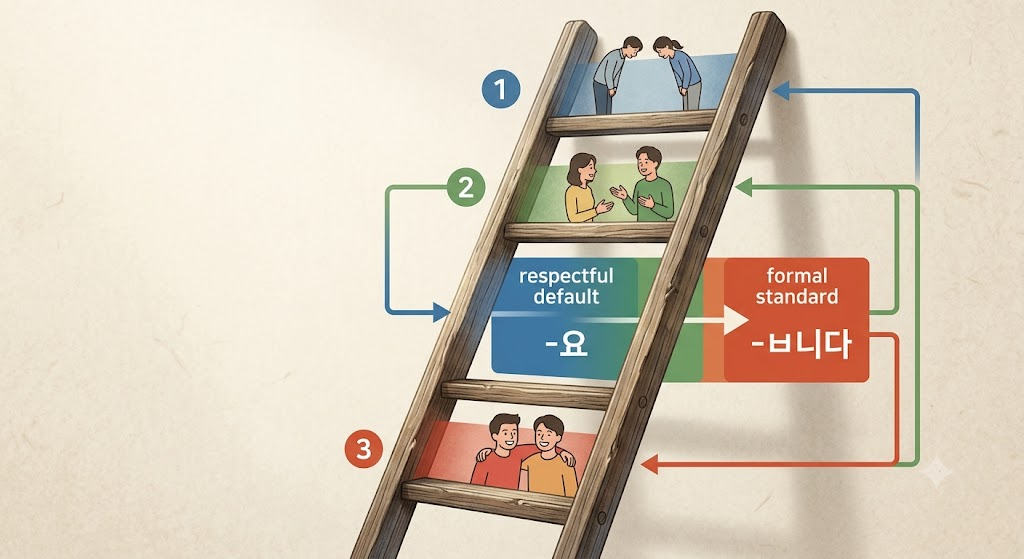
The Speech-Level Ladder
Within polite speech, there are two levels you’ll actually use, plus casual at the bottom:
- -습니다 / -ㅂ니다 (formal polite): 갑니다, 먹습니다. Crisp and professional — used in business meetings, presentations, reports, announcements, and service situations. It sounds distant and respectful.
- -요 (polite): 가요, 먹어요. The everyday polite standard — warm but respectful. This is your workhorse for daily life and most coworker conversation.
- 반말 (casual): 가, 먹어. No polite ending. For friends and juniors only.
There’s also the plain written form (-ㄴ다/-는다: 간다, 먹는다) you’ll see in books, news, and narration; spoken among peers it can sound blunt, so learners are safest sticking to the three levels above.
A simple mental model: -ㅂ니다 for formal, -요 for polite-friendly, 반말 for close.
How It Works at a Korean Workplace
The office has its own etiquette, and it trips people up:
- Use titles, not names. Address colleagues by rank + 님 — 팀장님 (team lead), 대리님, 과장님 — rather than their first name. Even calling a senior by name plainly can feel too casual.
- Keep 존댓말 with coworkers, including same-age ones, until you’re genuinely close. Defaulting to polite speech with peers is normal and expected, not stiff.
- Match the setting. In formal meetings and written reports, lean on -ㅂ니다. In friendly day-to-day chat with peers, -요 is perfectly appropriate. Modern offices use plenty of -요 among colleagues.
The safe posture: polite titles, -요 in casual work talk, -ㅂ니다 when it’s formal. You essentially never go wrong staying respectful.
Switching to 반말: How and Who Decides
So when do you get to relax into casual speech? Almost never unilaterally. The shift to 반말 is usually offered by the older or more senior person, or mutually agreed between peers of the same age. Jumping into 반말 on your own is the exact misstep my friend described.
The phrases that open that door:
- Shall we speak casually? → 말 놓을까요? (mal no-eul-kka-yo?)
- Is it okay if I speak comfortably? → 편하게 말해도 돼요? (pyeon-ha-ge mal-hae-do dwae-yo?)
When someone offers “말 놓자,” accepting is a small, warm milestone — like the way texting slang loosens as a friendship deepens. Until that moment, stay in 존댓말.

반존대: The Awkward In-Between
Real life isn’t always clean, so there’s a hybrid: 반존대 (ban-jon-dae) — “half-talk,” where you drop full politeness but don’t fully switch to 반말. You might soften endings casually while keeping a respectful tone. Koreans use it in ambiguous relationships — a coworker you’re warming up to, someone only slightly older — where full 반말 feels too forward but strict 존댓말 feels distant. You don’t need to master this early; just know that the register is a dial, not an on/off switch.
Common Mistakes to Avoid
- Going casual too fast. The number-one error. Wait to be invited into 반말.
- Using 반말 with customer-facing staff or elders. Always 존댓말 there.
- Calling seniors by name. Use rank + 님 at work.
- Fearing 존댓말 is cold. It isn’t — polite -요 is friendly and completely normal among peers. Over-politeness costs you nothing.
FAQ
What’s the difference between banmal and jondaetmal?
Jondaetmal is polite/respectful speech; banmal is casual/informal. Use jondaetmal with anyone older, senior, or new, and banmal only with close friends or juniors.
Should I use banmal with same-age coworkers?
Not at first. Keep 존댓말 (usually -요) until you’re genuinely close or you’ve mutually agreed to switch.
What’s the difference between -요 and -ㅂ니다?
Both are polite. -요 is warm and everyday; -ㅂ니다 is formal and professional, used in meetings, reports, and service settings.
How do I switch to casual speech politely?
Wait for the senior person to offer, or suggest it among peers with “말 놓을까요?” Don’t switch on your own.
The Bottom Line
Once you grasp banmal vs jondaetmal — defaulting to polite -요, using -ㅂ니다 when formal, and reserving 반말 for close, agreed relationships — you’ll navigate Korean workplaces and friendships without accidentally offending anyone. Use titles at work, let the senior person open the door to casual speech, and remember that being too polite is never the mistake. It builds directly on knowing how age sets titles and speech levels and pairs with reacting naturally in conversation. That new hire eventually learned to wait for the “말 놓자” — and fit right in. After this, so will you.
고구마





댓글 0
첫 댓글을 남겨보세요.