
Seoul Bus Guide for Foreigners (Colors & T-money)
There’s a bus stop right outside my restaurant in Mapo, and I’ve lost count of how many times I’ve watched a confused tourist flag down the wrong bus, ride two stops, and hop off looking defeated. Buses intimidate people far more than the subway does — there’s no map on a wall, the announcements fly by, and the doors close fast. But once you crack the simple color code, a Seoul bus guide for foreigners is honestly all you need, because Seoul’s bus network reaches places the subway doesn’t and gives you a street-level view of the city while you ride.

The Color Code (This Is the Whole Secret)
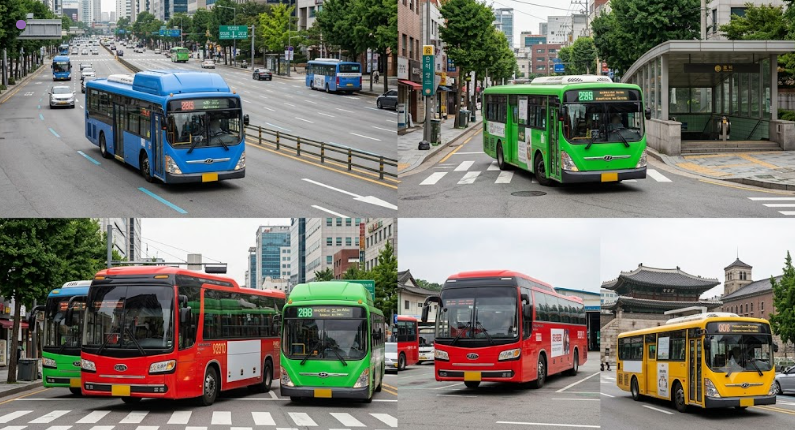
Seoul buses are color-coded by what they do, and knowing this instantly tells you whether a bus is useful to you:
- Blue (파랑) — 간선버스: main trunk routes running long distances across the city. Your workhorse for getting across Seoul.
- Green (초록) — 지선버스: shorter branch routes that feed neighborhoods and connect to subway stations. Great for that last stretch.
- Red (빨강) — 광역버스: wide-area express buses to the suburbs and Gyeonggi Province outside Seoul.
- Yellow (노랑) — 순환버스: short circular routes looping around the downtown core.
So if you’re crossing town, look for blue; if you’re hopping to a nearby subway station, green will do it; and if you’re heading out to the suburbs, you want red.
Tap On, Tap Off (Yes, Both)
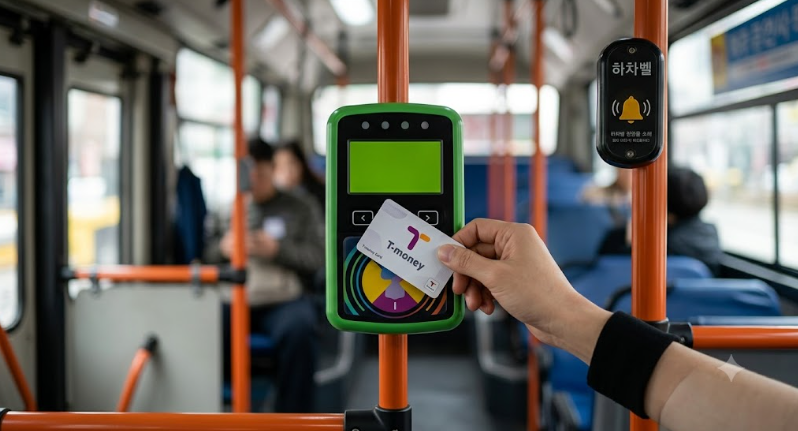
Just like the subway, you use your T-money card — and you tap twice: once when you board at the front, and once when you get off. That second tap matters. It’s how the distance-based fare is calculated and, crucially, how you keep your free transfer between buses and subway. Skip the tap-off and you can lose the transfer discount or face a penalty on your next ride.
The base fare sits in the mid-1,000-won range, and a bus-to-subway or bus-to-bus transfer within the time window is discounted or free — the same system that makes the subway such good value.
Don’t Miss Your Stop: The Bell
Buses only stop if someone’s getting on or if a passenger signals. So before your stop arrives, press one of the red stop bells (하차벨) mounted on the poles and near the doors. The bus announces upcoming stops (often with English), so listen for yours and hit the bell in time. Miss it, and you’re riding to the next one.
Finding the Right Bus
This is where a map app is non-negotiable: type your destination into Naver Map or KakaoMap, and it’ll tell you the exact bus number, which stop to catch it at, and real-time arrival minutes. I’ll never understand how anyone rode buses here before those apps — I certainly couldn’t do my supply runs without them. (More on that in the navigation guide.)
The Phrases That Help
- Does this bus go to ~? → 이 버스 ~ 가요? (i beo-seu ~ ga-yo?)
- Is the next stop ~? → 다음이 ~예요? (da-eum-i ~ye-yo?)
- Please stop (press the bell) → 벨 눌러주세요 (bel nul-leo-ju-se-yo)
That first one — “이 버스 [place] 가요?” — is your safety net. Ask the driver as you board, and a nod or headshake settles it before the doors close.
I still think the bus is the most underrated way to see Seoul. You get the city at eye level — the markets, the side streets, the neighborhoods the subway tunnels right past. Learn the colors, tap twice, and hit the bell in time. That’s genuinely the entire skill.
고구마





댓글 0
첫 댓글을 남겨보세요.